The gardener's eye

The Gardener's Eye

Monday, January 16, 2012

Monday, January 2, 2012

Bringing Tallamy Home to Peterborough


I have finally, after years of hearing about it, read Douglas Tallamy's 2007 book Bringing Nature Home. I have felt that I have been doing my part to help the environment in my public and private gardens. I have planted native as well as exotic plants in my gardens but have been careful to remove invasive plants like barberry, burning bush and bittersweet from the gardens. I have tried to plant trees and shrubs to provide food and shelter for birds. What I didn't understand was the importance of the foliage of native plants, in particular woody plants, as a source of food for insects which, in turn, supply food for birds, reptiles, amphibians and small mammals.

Tallamy has shown that most insects will only eat the foliage of trees and shrubs (with the exception of crabapples and several other exotic species) which they have evolved with for thousands of years. So my beautiful Katsura tree, Cercidiphyllum japonicum or the trifolaite maples, Acer triflorum and A. griseum x 'Gingerbread', that I adore, are not contributing to the food chain and biodiversity which is so important to our ecology. The good news is that oak trees are the number one woody plant to support Lepidoptera (bird food) and "serve as a host plant for 534 species of moths and butterfles." The two red oaks in my garden are making a huge contribution to biodiversity.

Tallamy maintains that "woody plants support much more biodiversity than herbaceous perennials and annuals. So, being creative with alien herbaceous plants is less harmful than using woody aliens. The number one herbaceous genus is Solidago, the goldenrods, but they only support 115 species. That is still a lot of biodiversity, but it is nearly five times less than oaks".

So it turns out, I haven't been doing as badly as I thought. All the public gardens have numerous crabapples which provide 311 species of Lepidoptera. The river birches, Betula nigra 'Heritage' that Gordon Hayward recommended at Depot Park support 413 species. The sugar maples at Teixeira Park provide 285 species and the beech trees at Putnam Park support 126 species.

My New Year's Resolution is to continue to pay attention to native plants in my public and private gardens. I love to experiment with exotic plants, but if I pay particular attention to the woody plants and make sure I have plenty of native asters, goldenrods, milkweeds and Joe Pye weeds, maybe I can have the best of both worlds.

Sunday, December 18, 2011

Villa Gamberaia: Source of Inspiration


The Water Parterre at Villa Gamberaia

I had the good fortune to attend the Chelsea Flower Show on two occasions. Each time, I was struck by the simple modern design of two foreigners: Swedish designer, Ulf Nordfjell, in 2007 and the Italian garden designer, Luciano Giubbilei last May.

Nordfjell's garden was a tribute to Carl Linnaeus and used a Swedish steel, timber and granite elements in a very simple but elegant design. The plant palette consisted of plants known to be cultivated by Linnaeus and plants commonly grown in Swedish gardens. The Giubbilei garden was equally simple and elegant with a pool, bamboo pavilion and sculpture by Peter Randall-Page. He used pink, maroon and brown flowers planted in romantic drifts to great effect.

Both designers have published books chronicling their work. Ulf Nordfjell: Fourteen Gardens and The Gardens of Luciano Giubbilei were coincidentally both published in English last year. I found it fascinating that they both site Villa Gamberaia, the Tuscan masterpiece, as an inspiration.

Nordfjell noted that at Villa Gamberaia "I found what I have often missed in other gardens: architecture, design, and the art of the garden, all unified by the stylistic ideals of the Renaissance man." He goes on to say that the villa "despite its age, feels like a modern and cohesively designed garden." Nordfjell fantasied "in my mind's eye, I find it irresistible to replace today's well-manucred lawns with ethereal beauty of the Tuscan landscape, creating an intimate tribute to nature from its own wildflowers: meadows of grape hyacinths, primulas. daisies and salvias, framed by formal hedging. This would, if such a thing is possible, enhance the genius of the Renaissance garden still further, forming a meeting between garden and the natural landscape, created by our human longing for beauty."

In his late teens, Giubbilei spent some time volunteering at Villa Gamberaia, being mentored by the head gardener, Silvano, who had worked there since the end of the Second World War. When Giubbilei left the villa, "Silvano presented him with a black-and-white record of the garden, a book that would prove a significant influence once his design career was under way. The atmospheric photographs by Balthazar Korab depicted both the architecture and mood of the garden: deep, rich shadows played on intensely lit surfaces, their textures almost tangible." Using these photographs as a model, Giubbilei "wanted to seduce people into entering gardens using the architecture of planting, the texture of the surfaces and the arrangement of sculpture, containers and furniture. His intention was never to imitate but to explore, to understand the sentiment behind the garden and the intensely motivating images."

During a family trip to Italy, I visited Villa Gamberaia in 2000. I was struck by the simplicity of the design and the intimacy of the scale of the garden. I learned the importance of having both shade and light in the garden and the clever use of terracing to divide spaces on a sloped site. I realized that I long for a design that is well-articulated and doesn't attempt to do too many things at once. It reminds me of the advice of an English professor who encouraged us "to say it, say it and say it again." The same clarity of intention is true about effective garden design.

Both of these designers have helped me distill what I found so alluring about Villa Gamberaia. Luciano Giubbilei has reminded me of the importance being influenced by other gardens and art but not to copy them verbatim and Ulf Nordfjell has galvanized in my mind the importance of well-chosen plants to create a desired effect within the confines of a strong design.

Sunday, November 27, 2011

Going, Going, Gone


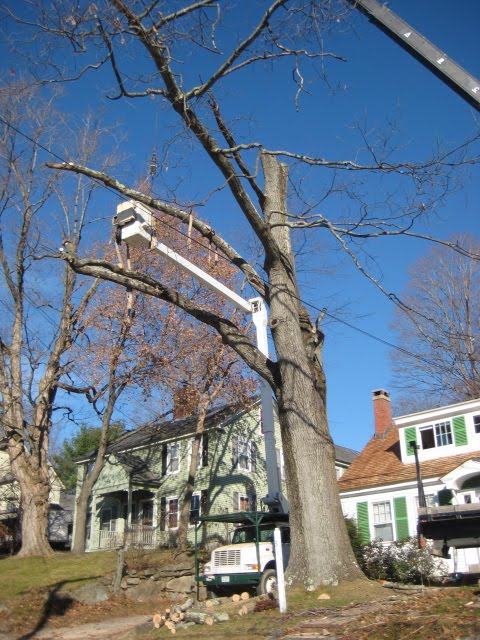
The Mighty Oak Tree on High Street

The View of the Crown of the Oak Tree From My Garden

Getting Ready to Remove the Oak

About Two Thirds of the Branches Have Been Removed

An Enormous Crane Carries the Huge Branches to the Ground

The Arborist Gets Ready to Attach the Cable to a Branch

The Main Trunk

Another Look at the Main Trunk

A Stump 64 inches in Diameter

Elephantine Logs

The Stump

The New Appearance of the House

The Large Oak in My Yard

The Small Oak in My Yard

I am not ordinarily a tree hugger, especially since we moved to New England. Turn your back on a field for 10 years and you have a science experiement illustrating the finer points of forest succession. At the turn of last century, something like 20% of New Hampshire was deforested. Today approximately 80% of the state is again woodland. Trees want to grow here. That said, there are some trees that I feel are sacred. The mammoth red oak, Quercus rubra, three houses down from our house on High Street was one such tree.

I became acquainted with this fine tree when I was searching for our first house in 1989. There were three houses in the neighborhood that I looked at. The old cape at the corner of High Street and Vine Street was very sweet but seemed a little small for our needs but I couldn't help but admire the enormous oak tree on the front yard. We ended up buying a house up the street and I was fortunate enough to pass this glorious tree on my walk to work each morning.

Early one morning last spring, I was driving to go on a hike and I couldn't help but notice that an enormous branch had broken off the tree and crushed the second floor of the house. Fortunately, the owners sleep on the ground floor and no one was hurt. During the summer, the entire second floor was replaced by the insurance company. Their only caveat was that the tree had to be removed in order for the owners to remain insured.

Last week, the Arborists arrived and methodically removed the tree, branch by branch, with a pair of cranes. I had always figured the tree was ancient but the aborist determined that it was about 150 years old. The remaining stump was 64 inches in diameter. There are two red oak trees in my garden. One is about 90 years old the other is probably about 45 years old. I take comfort in believing that my trees are the progeny of that magnificent tree down the street.


Sunday, November 20, 2011

Pruning Inspiration From Pack Monadnock

Gnarly Oaks at the Peak of Pack Monadnock

The silhouette of Oaks in the Direction of Mount Washinghton

A Crabapple tree that was on the Property when we bought the House in 1989

Magnolia sieboldii Artfully (I hope) pruned

Limbed up Cornus officinalis

I hike Pack Monadnock, a mountain near my house, about 5 or 6 mornings a week. It is a 1.3 mile march up the road to the peak of the mountain--I think of it as my personal outdoor stair-master. At the top of Pack, there is a group of oak trees that, due to the extreme weather, have never gotten a chance to reach their mature size and have developed a gnarly shape over the years. I love the silhouette they produce in the sky. I often refer to my memory of them as I am pruning the small trees in my garden. Now that the leaves have fallen off the trees, it is an excellent time to evaluate the lines of the trunks and make some adjustments in order to make the branches on the trees just a little more intriguing.


Sunday, November 13, 2011

Thanks for Another Great Season

The volunteer gardeners had their last work day a couple weeks ago and I wanted to thank them for all their efforts this gardening season. This was our 12th year working together in the parks of Peterborough.

Back row: Nancy O'Neill, Laura Trowbridge, Mollie Amies, yours truly and Terry Reeves. Front row: Maude Odgers, Molly Beyer, Jeannie Connolly and Bob Wilder, town employee. Missing from the picture: Susannah Parish, Amy Manny and Sarah Bay.

LinkWithin

Related Posts with Thumbnails