The gardener's eye

The Gardener's Eye

Showing posts with label Chionodoxa. Show all posts

Thursday, March 24, 2016

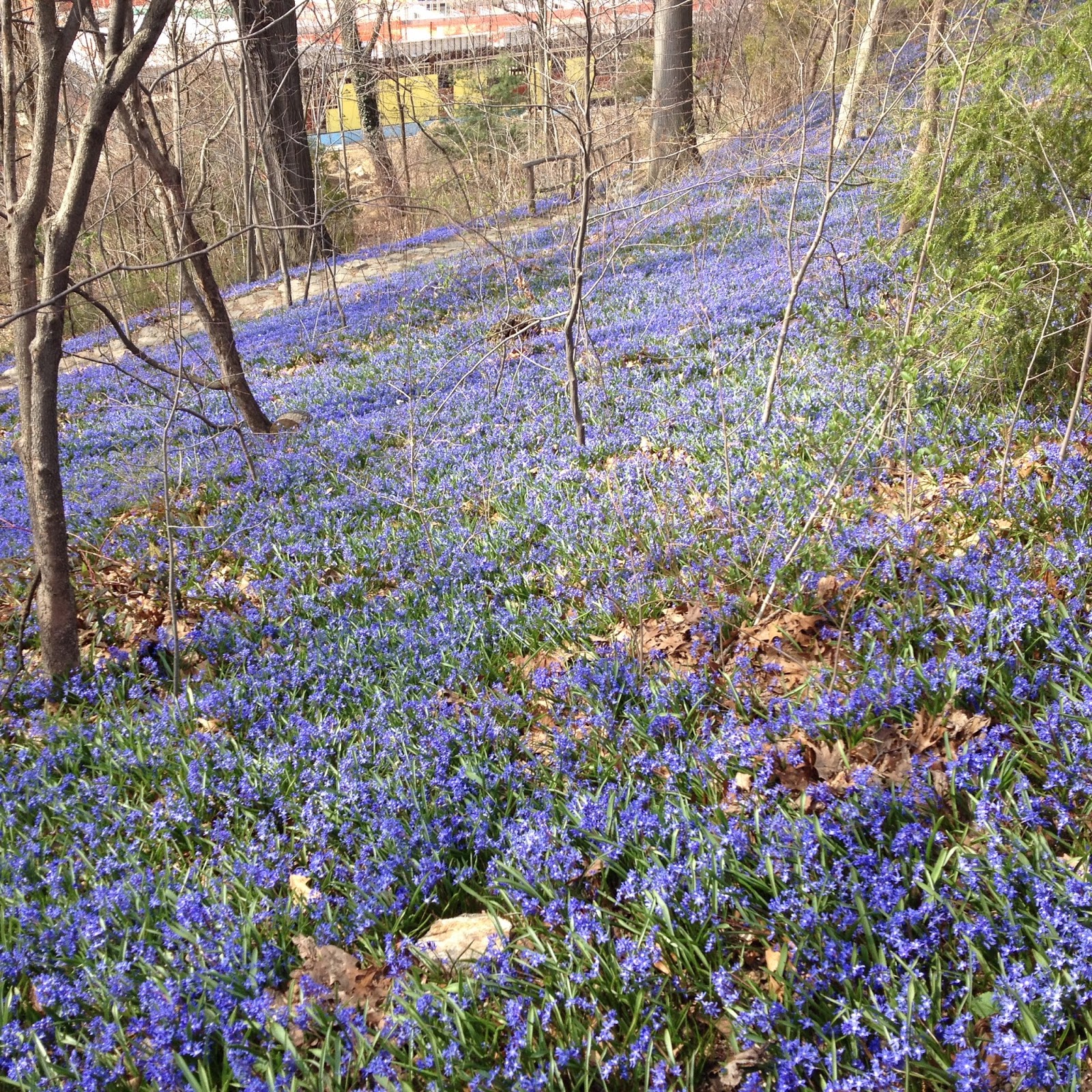
Wave Hill's Chionodoxa are Back and So Am I


I have been on hiatus from blogging but a recent visit to Wave Hill in the Bronx during peak Chionodoxa sardensis season has inspired me to return. I was at lecture by Luciano Giubbilei at the New York Botanical Garden today and took a detour to nearby Wave Hill to see the drifts of glory-in-the-snow on the slope of the Abrons Woodland. The beautiful blue minor bulb has naturalized in the woodland as well as in the lawn under large trees and even in the Flower Garden. I hope my own woodland garden might get the blues this badly one day.


Thursday, November 15, 2012

New "Layered" Plantings at Teixeira Park


The Ruin Garden at Teixeira Park has had five years to settle down and fill in. The dozen Malus 'Prariefire' trees along the sidewalk have gotten larger and fruited well. The theme has always been to be a wild garden, attracting birds and butterflies. A common complaint was that the garden felt isolated in the park and the suggestion was to add plantings on the outside of the granite walls of the Ruin Garden to soften them. My thought has always been that as the granite ages and the plants spill out, the garden will mature and its hidden nature will beckon visitors to enter and explore the garden; that being partially concealed was part of the allure. 

But after careful consideration, we decided to plant the two triangular areas formed by the pathways at each end of the park. The East end is full sun and the West end is partial shade. I wanted to continue the wild theme and the paths, like the granite walls in the Ruin garden, made the boundaries very clear, which from a maintenance perspective is a good thing. We would now have three related gardens with overlapping plant lists that would talk to each other and create a repetition of gardens over the entire park as seen from the road. Hopefully the Ruin Garden wouldn't feel isolated, but rather, integrated into the landscape.


The Ruin Garden at Teixeira Park


Waking toward the West Garden from the Ruin Garden


The Part-Shade West Garden at Teixeira Park


The Sidewalk Looking toward the East Garden--Malus 'Prariefire' to the right


The East Garden at Teixeira Park

I have spent many hours studying Piet Oudolf's work in books and have seen three of his designs in person: the Glasshouse Borders at Wisley in England, The High Line and the Gardens of Remembrance in Manhattan. I was particularly  interested in his "layered" approach to planting that Noel Kingsbury describes in the book Landscapes in Landscapes. The first layer is the "martix planting of ground-covering, relatively low growing plants. The next layer is the "island plants where irregularly shaped beds are planted with a mixture of grasses (and in my case, also perennials) for a late-summer-to-winter period of interest." The final layer is "the scatter plants, taller species, often colorful or with distinct structure." We also added trees and shrubs with colorful fruit and bulbs for interest in the early spring. Below is the plant list. Time will tell if our planting will be successful.

The East Garden Plant List

Trees/Shrubs
Viburnum dentatum 'Blue Muffin'

Matrix Planting
Sesleria autumnalis
Heuchera villosa 'Autumn Bride'
Aster macrophyllus

Island Plants
Helianthus occidentalis
Liatris ligulistylis
Monarda fistulosa
Solidago speciosa
Sporobolus heterolepsis
Solidago rigida

Scatter Plants
Eupatorium purpureum
Helianthus salicifolius
Sorghastrum nutans
Silphium perfoliatum

Bulbs
Camassia leichtlinii 'Blue Danube'
Chionodoxa sardensis
Tulipa sylvestris

The West Garden Plant List

Trees/Shrubs
Cornus mas


Matrix Planting
Sesleria autumnalis
Heuchera villosa 'Autumn Bride'
Aster macrophyllus

Island Plants
Helianthus stromusus
Aster divaricatus
Sporobolus heterolepsis

Scatter plants
Eupatorium purpureum
Aruncus aethusifolia
Aralia racemosa


Bulbs
Camassia leichtlinii 'Blue Danube'
Chionodoxa sardensis
Hyacinthoides non-scripta
Tulipa sylvestris


Saturday, April 23, 2011

I Guess That's Why They Call it "Glory of the Snow"

Cornus officinalis and Chionodoxa sardensis

Helleborus x hybrids Heronswood Slate looks praiseworthy with a dusting of snow

A welcome arrival: Five Cussonia paniculata plants

As I was sipping my wake-up cup of coffee and reading a post on one of my favorite blogs,
A Tidewater Gardener, about all the luscious bearded irises blooming in Les' Norfolk, Virginia garden, it began to snow. About half an hour later, the entire garden was white...again! It seemed appropriate that the Chionodoxa sardensis were in bloom.

Chionodoxa, also known as "glory of the snow", are my favorite late winter bulbs and they couldn't be easier. Use them to underplant any shrub, tree or woodland and wait for them to multiply and before you know it, you will have masses of clear blue star-like flowers carpeting your garden. We use a very similar species, Chionodoxa luciliae, to underplant shrubs and in the borders throughout the parks in Peterborough. Each year, as they naturalize, they make a bigger and bigger statement unifying these spaces throughout the downtown public gardens.

Fortunately, a hopeful harbinger of the summer garden arrived yesterday: Five Cussonia paniculata plants from Annie's Annuals. Cussonia paniculata, as described in the catalogue, is
"a wonderful specimen plant that looks straight out of Dr. Seuss, but is really from South Africa, “Mountain Cabbage Tree” makes a small tree, 9-12’ tall, with a curvy, corky, sturdy trunk topped by superb looking blue-gray leaves that are large and palmate -divided and subdivided into segments like a snowflake".

I had first was introduced to Cussonia paniculata at Wave Hill, the inspiring public garden in the Bronx, and finally got a plant about 8 years ago. After two seasons, it developed into a magnificent small tree that I overwintered in our walk-out basement. Sadly, I killed it two years ago. I am pleased to have it again. I am planning to let one mature in a pot to be used on my terrace. The remaining four plants will be used as textural components to the Pavilion Garden at Depot Park this summer. And yes, there will be summer this year!


LinkWithin

Related Posts with Thumbnails