The gardener's eye
The Gardener's Eye
Monday, May 25, 2015
Friday, May 22, 2015
Rousham House and Gardens
Before visiting Pettifers Garden, I
stopped to see Rousham House and Gardens in Oxfordshire. I am also hoping to
include Rousham in next year’s tour. Rousham Gardens’ reputation preceded my
visit. It is arguably one of the finest gardens in England. Rousham remains a private garden and was
surprisingly quiet, especially as compared to another landscape garden we visit,
Stourhead, which is owned and operated by the National Trust and had hundreds
of visitors when we were there last week. I saw perhaps 10 visitors at Rousham and felt as
if I had the garden to myself for the morning.
Rousham is an excellent example of an
Augustan age (early 18th century when British artists emulated the original Augustan age in Rome 27 BC-14AD) landscape garden and was designed by William Kent (1685-1748). It is
recommended to follow the circuit walk, drawn up prior to 1738 by the head
gardener, John MacClary. My photographs follow the circuit which takes the
visitor around the perimeter of the garden through a series of water features,
statues and follies.
Rousham House and Gardens is still
owned by the same family that created it and remains precisely as Kent
envisioned. The brochure for Rousham says it all: “Rousham is uncommercial and
unspoilt with no tea room and no shop. Bring a picnic, wear comfortable shoes
and it is yours for the day.”
Rousham House from the Bowling Green
The view from the house with central statue made in 1740.
The Lion and the Horse by P. Scheemaker
The Octagon Pond
The Upper Cascade with a statue of Venus
The Watery Walk
The serpentine rill in the Watery Walk is elegant and feels contemporary even today
The octagonal Cold Bath
Temple of Echo by Kent and Townsend
Paladian Doorway
View of the house; the ha-ha can barely be discerned
Statue of Apollo
Heyford Bridge 1255
The reverse view of Apollo through The Long Walk
The Lower Cascade with the Upper Cascade above
The Arcade
The ancient hedges that separate the Bowling Green from the Walled Garden
The Walled Garden predates the work of William Kent
The formal Pigeon House Garden
Monday, May 18, 2015
Visiting Pettifers Garden
If Piet Oudolf’s garden and Helen Dillon’s garden had a child, it would
surely be Gina Price’s garden, Pettifers. I had the good fortune to visit
Pettifers Garden while in England for The Best of English Gardens Tour. I took a
day away from the group to do reconnaissance for next year’s tour.
Pettifers Garden, in Oxfordshire, has been on my radar for several years now. I have spent many hours surveying photographer Clive Nichols' luscious photographs of the garden throughout the seasons on his website. Gina’s head gardener, Polly Stevens, took me on a tour of the garden and it became immediately clear this is a plantwoman’s garden. Gina has lived at Pettifers since 1984, but became interested in gardening after learning about The New Perennial Movement which championed grasses in borders. Over time, grasses and perennials have replaced roses and shrubs. Interestingly, several shrubs, like various Cotinus species, have been slowly added in recent years.
Nothing is sacred in the garden and plants are constantly being moved or replaced if the garden picture isn’t pleasing. Gina has combined grasses, which will peak in the late summer, with flowering perennials in an engagingly loose formality. To my eye, she combines the best of Oudolf's naturalistic style with Dillon's gorgeous plantings; reinterpreting and combining each style in a unique and fresh way. Gardening friends had recommended that she enclose the garden with walls dividing the garden into rooms which Gina resisted. The result is a garden that has the open feeling which talks full advantage of the magnificent views of the countryside. I would love to visit this garden many times throughout the year and hope to include it in next year's tour.
The view from the house. Cornus
alternafolia ‘Variegata’ to the left in the foreground. I hadn’t expected
to such an open space in the center of the garden. In the distance, the borrowed
landscape of the far hills makes the garden seem much larger than its one and a
half acres.
A long border backed by a formal yew
hedge.
A stunning foliage combination of
epimedium, euphorbia and rodgersia.
The formal, yet contemporary, Parterre Garden has become as iconic as Oudolf’s waved hedges at Hummelo or the central canal at Helen Dillon’s garden in Dublin, Ireland.
An allee of Malus transitoria, the cut-leaf crabapple, was at its absolute peak while I was visiting.
A close up view of the flowers. The almost
willow-like foliage was particularly fresh looking.
Cornus
controversa ’Variegata’ to right in the lower garden.
Looking up at the house through the
Parterre Garden.
A cross-sectional view of the house
and retaining wall.
The tulips in the Parterre Garden are
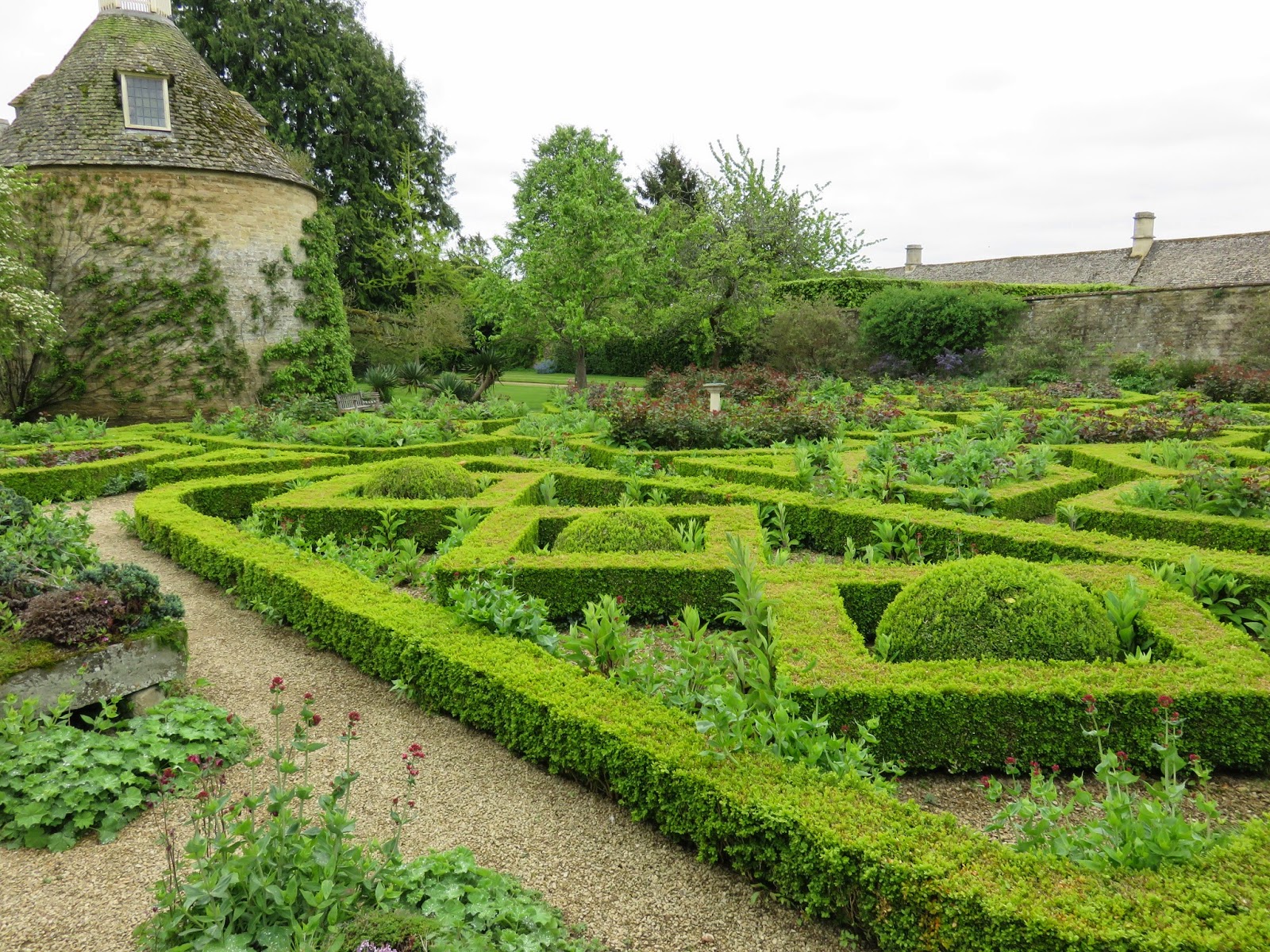
a color echo the magnolia that can be seen through the yew ‘chimneys'.
The dark purple of the 'Black Parrot' tulips contrast
with the lawn and the chartreuse-foliaged plant at the edge of the border.
Sunday, May 17, 2015
Pairs, Spares and Bears
Before plants leaf out is the perfect time to examine the placement of hardscape elements and
evergreens in the garden. It is the logical place that I like to begin when I design a garden: make it
look good in the the winter and you are off to a good start. New Hampshire
granite and round boxwoods are the unifying elements in my garden. I
contemplate box placement this time of year; perhaps too much. My garden has many
classical symmetrical design elements. There are multiple focal points in the garden that call
for some symmetry. In the Upper Garden, I placed a pair of boxwoods to
frame the focal point, a Cornus officinalis tree. The symmetry
was too 'perfect' and several years later, I added another single
boxwood creating symmetry and asymmetry simultaneously. I call it 'a
pair and a spare'. In other parts of the gardens I have designed, I have
placed boxwoods in 'one', 'twos' and 'threes'. When I do that, it
reminds me of the three bears; Papa bear, Mama bear, and Baby bear. In
the Upper Garden the far end has 'a pair and a spare'. To the right
there is a 'two' or a Mama bear/Baby bear combo and a single 'one' by itself to the far right.
The pair of stewartias on either side of the granite bench focal, a central focal point, were supposed to be symmetrical. However, I planted them from seed collected at the Arnold Arboretum and they were siblings with the same mother but different fathers. Clones would have been symmetrical, if I had thought of that, I may have done that. For many years there different size and bark attributes of each plant bothered me. A couple years ago, I added a third very small stewartia to the right of the midline. The third stewartia created a simultaneous symmetrical and asymmetric dynamic again.
At the steps leading from the Blue Bench Terrace, I planted a pair of cherry trees, Prunus x 'Hally Jolivette’, that will create an archway over time. I added a third on the left, and slightly down hill to create a grove, while the top two trees remain symmetrical. There was just a pair of boxwoods flanking the stairs when I first planted this garden. In some ways it felt too perfect and it didn't stop the eye from proceeding to the next garden. I added a single on the right and a pair, one larger, the other smaller, on the left. I this way, I kept the symmetry and created a grouping at the same time.
This year I began to add a handfull of boxwoods in the lowest garden, the Woodland Garden. I don't want it to appear too formal but I was interested in creating the impression that several balls escaped their formal confines in the two upper gardens and rolled into the wild garden. Time will tell if this was a good idea.
The pair of stewartias on either side of the granite bench focal, a central focal point, were supposed to be symmetrical. However, I planted them from seed collected at the Arnold Arboretum and they were siblings with the same mother but different fathers. Clones would have been symmetrical, if I had thought of that, I may have done that. For many years there different size and bark attributes of each plant bothered me. A couple years ago, I added a third very small stewartia to the right of the midline. The third stewartia created a simultaneous symmetrical and asymmetric dynamic again.
The Upper Garden from the bedroom window. The tumble of boxwoods appear to be 'rolling" down the hill in the Hall with Balls
A pair and a spare configuration looking into the Hall with Balls from the Upper Garden
A Mama bear/Bady bear combination in the Upper Garden
Balls "rolling" down the hill
Another view looking down the steps in the Hall with Balls
The
third stewartia is barely visible from above. I like the idea that the
original pair are placed symmetrically and the third smaller tree will
create a Papa bear/Mama bear/Baby bear grove one day.
At the steps leading from the Blue Bench Terrace, I planted a pair of cherry trees, Prunus x 'Hally Jolivette’, that will create an archway over time. I added a third on the left, and slightly down hill to create a grove, while the top two trees remain symmetrical. There was just a pair of boxwoods flanking the stairs when I first planted this garden. In some ways it felt too perfect and it didn't stop the eye from proceeding to the next garden. I added a single on the right and a pair, one larger, the other smaller, on the left. I this way, I kept the symmetry and created a grouping at the same time.
This year I began to add a handfull of boxwoods in the lowest garden, the Woodland Garden. I don't want it to appear too formal but I was interested in creating the impression that several balls escaped their formal confines in the two upper gardens and rolled into the wild garden. Time will tell if this was a good idea.
Monday, May 4, 2015
Narcissus 'Barrett Browning' at Peter's Gate
Last October, we planted Narcissus 'Barrett Browning' in pots and placed them underground for the winter. In mid-April, we moved the plants in bud to the large pots at Peter's Gate in Depot Park. Later this month, we will transplant them into the new garden adjacent to the Bocelli Garden. This way, the daffodils perform double-duty. 'Barrett Browing' is a particularly good cultivar for this purpose because it is an excellent perennializer. It is an early small-cupped daffodil with pure white petals blushed with faint light yellow. The cup is a brilliant red-orange that can be seen from a long distance. On top of that, 'Barrett Browning' has a lovely fragrance which can be enjoyed in a pot or a vase.
Subscribe to:
Posts (Atom)