The gardener's eye

The Gardener's Eye

Saturday, February 25, 2012

Liebster Blog Heart


Yesterday, I had the pleasure of receiving word from a fellow blogger, Hans of Svanå trädgård, that he had nominated me for a Liebster Blog Award. Apparently, it is given to bloggers who have less than 200 followers in order to spread the word about interesting blogs. Thanks Hans, for recognizing my blog.

Hans is an amateur gardener who lives in Boden, Norrbotten, Sweden with his wife and three children. His blog chronicles his "little garden" where he likes to try different plants to see if they can survive in the harsh conditions of his Zone 4 garden. The first plants he experimented with were from the forgotten garden marshlands next to his village, Svanå, where his blog it its name.

Interestingly enough, Hans selected gardening blogs for the Liebster Blog Award from countries that don't even speak Swedish. I would like to accept Hans' challenge and recommend five blogs, from both far and near, that I find intriguing:


James Golden at View from Federal Twist James eloquently writes about his two gardens, one is large garden in western New Jersey, called Federal Twist, and other is a small urban garden in Brooklyn. Federal Twist is an established 'New American' garden and has a diverse selection of prairie plants. The Brooklyn garden is a work in progress and looks like it will have a modern bent to it.

Jordan Jackson at Metropolitan Gardens: Gardening in Cascadia . Jordan is a professional landscape designer, and has a Zone 8 garden, called the Cascadia Garden, in Seatle, WA. His blog provides information about gardening in northwestern United States. He puts together an excellent list of 'plants of interest' in his garden each month.

Faisal Grant at Gardener in the Distance . Faisal is a garden-maker from Melbourne, Victoria, Australia. He is also a poet and it is not uncommon to find his poetry in posts on his blog. I always enjoy finding out what is happening in the southern hemisphere each season.

Joe Valentine at Juniper Hill. Joe is a gardening friend of mine from here in New Hampshire. He has two acres of ornamental and vegetable gardens at Juniper Hill Farm, the 18th century farmstead he shares with his partner-in-life, Paula. He is a bit of a boxwood aficionado and his blog often features guest bloggers from our area.

David Marsden at The Anxious Gardener. David is a professional gardener working in East Sussex, England. He has been blogging about the two gardens he works on for about a year. His blog is always full of both humor and useful information.

The rules to accepting the Liebster Blog Award are:

• Thank your Liebster Blog Award presenter on your blog.
• Link back to the blogger who presented the award to you.
• Copy and paste the blog award on your blog.
• Present the Liebster Blog Award to 5 blogs of 200 followers or less who you feel deserve to be noticed.
• Let them know they have been chosen by leaving a comment at their blog.

Wednesday, February 15, 2012

What a Difference a Dusting Makes

Hall with Balls

The Upper Garden

Lower Garden looking at the House

Lower Garden looking from the House

The Blue Bench Terrace

The Pavilion at Depot Park

Yew Waves

More Yew Waves

Depot Park

Nubanusit Terrace

Entrance to Putnam Park

Boccelli Garden

Post in Boccelli Garden

Teixeira Park

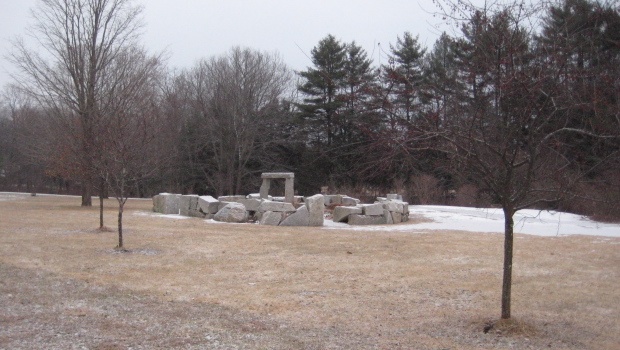
Ruin Garden at Teixeira Park

Butterfly Weed

Ironweed in Snow

Bench at Teixeira Park

View from Pack Monadnock Road

Nature's Design

The Top of Pack Monadnock

Sunday, February 12, 2012

More Winter Interest from the Arnold Arboretum


Lindera umbellata

Lindera angustifolia

One can't help but notice the spicebush grove on the North side of Bussey Hill Road near the Lilac collection at the Arnold Arboretum. The persistent tawny-tan foliage of Lindera umbellata and Lindera angustifolia are nearly indistinguishable from one another. Both shrubs have narrow glossy green foliage with silver undersides earlier in the season. The greenish-yellow flowers in April produce small round black fruit on female plants. L. angustifolia has strawberry pink foliage in autumn and is hardy to zone 5 while L. umbellata leaves turn yellow in fall is only hardy to zone 6.

Monday, February 6, 2012

I Found My Thrill on Bussey Hill


I had a drawing class last Sunday near the Arnold Arboretum and decided to spend an hour or two roaming the grounds looking for interesting trees and shrubs. February is the perfect month to search for examples of plants with exceptional winter interest and there is no better spot at the Arnold Arboretum than the Explorers Garden on Bussey Hill. The Explorers Garden is on a protected slope and has specimens of unusual trees from around the world.

After taking their propagation course, I was able to collect seeds from plants at the arboretum to grow in my own garden. I propagated two Stewartia pseudocamellia trees in 1996 from seeds collected from a tree here on Bussey Hill. Sixteen years later, I have two 12 foot tall trees in my Lower Garden form Arnold Arboretum parents. I had mistakenly assumed these trees would be twins but soon discovered that I knew only one parent for certain. In fact, I may have created a cross of two different species of stewatias.

Stewartia monadelpha has a chocolate-colored exfoliating bark

A close up of the bark of Stewartia monadelpha

Stewartia sinensis, the Chinese Stewartia, has a more subtle bark

A closer look at Stewartia sinensis

I collected seed from this specimen of Stewartia pseudocamellia which was propagated from seed collected in Korea by E. H. Wilson in 1917

The muscular trunks of Stewartia pseudocamellia remind me of a boa constrictor

This ancient Acer griseum tree was brought, as a seedling, by Wilson from China to Boston in 1907. This specimen is thought to be the source of the first generation of paperbark maples planted in North America.

Acer griseum Accession number: 12488

The cinnamon-colored bark of the oldest Acer griseum specimen in the United States

Ulmus parvifolia or the Chinese Elm is a graceful tree that grows 40-50 feet in height in cultivation and makes it an ideal shade, specimen or street tree.

The showy exfoliating bark of Ulmus parvifolia displays random, mottled patterns of grey, green, orange, and brown

Pinus densiflora 'Umbraculifera' near the Conifer Path at the Arnold Arboretum

Pinus densiflora 'Umbraculifera' is a slow-growing dwarf cultivar that is often grown as multi-trunked small tree with handsome orange-red bark

I noticed the tan bark of Corylus fargesii, a new tree to me, from quite a distance away as I was walking on Valley Road at the Arnold Arboretum. I was certain that it was Acer triflorum but was mistaken.

The peeling copper-colored bark of Corylus fargesii, the Farges filbert, rivals any tree on Bussey Hill and looks very similar to the River Birch, Betula nigra. It can grow over 100 feet tall in its native China. I think it would make a magnificent specimen tree.

Monday, January 16, 2012

Monday, January 2, 2012

Bringing Tallamy Home to Peterborough


I have finally, after years of hearing about it, read Douglas Tallamy's 2007 book Bringing Nature Home. I have felt that I have been doing my part to help the environment in my public and private gardens. I have planted native as well as exotic plants in my gardens but have been careful to remove invasive plants like barberry, burning bush and bittersweet from the gardens. I have tried to plant trees and shrubs to provide food and shelter for birds. What I didn't understand was the importance of the foliage of native plants, in particular woody plants, as a source of food for insects which, in turn, supply food for birds, reptiles, amphibians and small mammals.

Tallamy has shown that most insects will only eat the foliage of trees and shrubs (with the exception of crabapples and several other exotic species) which they have evolved with for thousands of years. So my beautiful Katsura tree, Cercidiphyllum japonicum or the trifolaite maples, Acer triflorum and A. griseum x 'Gingerbread', that I adore, are not contributing to the food chain and biodiversity which is so important to our ecology. The good news is that oak trees are the number one woody plant to support Lepidoptera (bird food) and "serve as a host plant for 534 species of moths and butterfles." The two red oaks in my garden are making a huge contribution to biodiversity.

Tallamy maintains that "woody plants support much more biodiversity than herbaceous perennials and annuals. So, being creative with alien herbaceous plants is less harmful than using woody aliens. The number one herbaceous genus is Solidago, the goldenrods, but they only support 115 species. That is still a lot of biodiversity, but it is nearly five times less than oaks".

So it turns out, I haven't been doing as badly as I thought. All the public gardens have numerous crabapples which provide 311 species of Lepidoptera. The river birches, Betula nigra 'Heritage' that Gordon Hayward recommended at Depot Park support 413 species. The sugar maples at Teixeira Park provide 285 species and the beech trees at Putnam Park support 126 species.

My New Year's Resolution is to continue to pay attention to native plants in my public and private gardens. I love to experiment with exotic plants, but if I pay particular attention to the woody plants and make sure I have plenty of native asters, goldenrods, milkweeds and Joe Pye weeds, maybe I can have the best of both worlds.

Sunday, December 18, 2011

Villa Gamberaia: Source of Inspiration


The Water Parterre at Villa Gamberaia

I had the good fortune to attend the Chelsea Flower Show on two occasions. Each time, I was struck by the simple modern design of two foreigners: Swedish designer, Ulf Nordfjell, in 2007 and the Italian garden designer, Luciano Giubbilei last May.

Nordfjell's garden was a tribute to Carl Linnaeus and used a Swedish steel, timber and granite elements in a very simple but elegant design. The plant palette consisted of plants known to be cultivated by Linnaeus and plants commonly grown in Swedish gardens. The Giubbilei garden was equally simple and elegant with a pool, bamboo pavilion and sculpture by Peter Randall-Page. He used pink, maroon and brown flowers planted in romantic drifts to great effect.

Both designers have published books chronicling their work. Ulf Nordfjell: Fourteen Gardens and The Gardens of Luciano Giubbilei were coincidentally both published in English last year. I found it fascinating that they both site Villa Gamberaia, the Tuscan masterpiece, as an inspiration.

Nordfjell noted that at Villa Gamberaia "I found what I have often missed in other gardens: architecture, design, and the art of the garden, all unified by the stylistic ideals of the Renaissance man." He goes on to say that the villa "despite its age, feels like a modern and cohesively designed garden." Nordfjell fantasied "in my mind's eye, I find it irresistible to replace today's well-manucred lawns with ethereal beauty of the Tuscan landscape, creating an intimate tribute to nature from its own wildflowers: meadows of grape hyacinths, primulas. daisies and salvias, framed by formal hedging. This would, if such a thing is possible, enhance the genius of the Renaissance garden still further, forming a meeting between garden and the natural landscape, created by our human longing for beauty."

In his late teens, Giubbilei spent some time volunteering at Villa Gamberaia, being mentored by the head gardener, Silvano, who had worked there since the end of the Second World War. When Giubbilei left the villa, "Silvano presented him with a black-and-white record of the garden, a book that would prove a significant influence once his design career was under way. The atmospheric photographs by Balthazar Korab depicted both the architecture and mood of the garden: deep, rich shadows played on intensely lit surfaces, their textures almost tangible." Using these photographs as a model, Giubbilei "wanted to seduce people into entering gardens using the architecture of planting, the texture of the surfaces and the arrangement of sculpture, containers and furniture. His intention was never to imitate but to explore, to understand the sentiment behind the garden and the intensely motivating images."

During a family trip to Italy, I visited Villa Gamberaia in 2000. I was struck by the simplicity of the design and the intimacy of the scale of the garden. I learned the importance of having both shade and light in the garden and the clever use of terracing to divide spaces on a sloped site. I realized that I long for a design that is well-articulated and doesn't attempt to do too many things at once. It reminds me of the advice of an English professor who encouraged us "to say it, say it and say it again." The same clarity of intention is true about effective garden design.

Both of these designers have helped me distill what I found so alluring about Villa Gamberaia. Luciano Giubbilei has reminded me of the importance being influenced by other gardens and art but not to copy them verbatim and Ulf Nordfjell has galvanized in my mind the importance of well-chosen plants to create a desired effect within the confines of a strong design.

LinkWithin

Related Posts with Thumbnails