The gardener's eye

The Gardener's Eye

Sunday, July 15, 2012

The Ruin Garden Evolves: Letting Nature Take its Course


The Ruin Garden at Teixeira Park


Textures in the Garden: Calamagrostis brachytricha in the foreground


Volunteer Goldenrod allowed to enter the garden


Echinacea, Butterflyweed and the fine foliage of Vernonia lettermannii 'Iron Butterfly' in foreground


Close up of the original Asclepias tuberosa 'Gay Butterflies'  and Heliopsis helianthoides 'Summer Nights'

Asclepias tuberosa 'Gay Butterflies' and Heliopsis helianthoides 'Summer Nights' are the stars of the Ruin Garden in early July. They are good companions. Asclepias tuberosa 'Gay Butterflies'  is a short and squat plant of about 24" with bright orange flowers.  Heliopsis helianthoides 'Summer Nights' is slim, airy and stands about 3-4 feet tall on elegant red-tinged stems.  The golden flowers tower above the low granite walls at the Ruin Garden and can be seen from the sidewalk on Union Street inviting the passerby to explore the garden.

Both plants are cultivars of Native American plants that attract butterflies. The seeds of Heliopsis helianthoides 'Summer Nights' also provide food for goldfinches. Interestingly, both of these plants are self-seeding in the garden. I want the Ruin Garden to have a wild feeling and I am letting some of the volunteers grow where they please but I am editing out other plants that may overwhelm neighboring plants. 

This garden is a bit of an experiment for me. I usually like to control what happens in the garden. I am working on removing any unhappy species and letting the happy plants be fruitful and multiply. I want the Ruin Garden to attract birds and butterflies and be full of a diverse combination of plants that look good throughout the year. It is more difficult task to do well than one might think.

Wednesday, July 4, 2012

Before and After at the Pavilion Garden


The trimming of the hedges at the Pavilion Garden at Depot Park is always a turning point in the season for the public gardens. I love the contrast of the neatly sculpted hedges with the fluff of the grasses and maturing annuals in the garden. It is most effective at the end of the season right before frost when the annuals are in full swing. It is a lot of work but only needs to be done once if you wait until early July.

Sunday, July 1, 2012

What is it?


5) Aralia cordata 'Sun King' 


4) Stewartia pseudocamellia


3) Persicaria polymorpha


2) Eryngium giganteum 'Miss Willmott's Ghost'


1) Onopordum acanthium aka Scotch Thistle

We had about 150 visitors to the garden yesterday for the Monadnock Region Garden Conservancy Open Day. It was a hot, sunny day with a refreshingly pleasant breeze. The most asked about plant in the garden was the enormous Scotch Thistle, Onopordum acanthium. This biennial is a favorite of mine because it has a such a commanding presence in the garden. When it goes to seed, it becomes ratty looking and I immediately take it out. It needs to be removed carefully because the spines are razor shape. For some people it is an intimidating plant but for me, at 6 foot three, it is one of the few herbaceous plants that I can look up to.

Saturday, June 23, 2012

Monadnock Region Open Day June 30


The Garden Conservancy Open Day in the Monadnock Region will be next Saturday, June 30. My garden, along with four other gardens, will be open to the public from 10 am to 4 pm. If you are in the area, please come by for a visit. Each garden is different from the next and the tour would make for a lovely day. The public gardens that I work on in Peterborough, which are always open to the public, are also included on the Open Days Tour. Volunteer gardeners will be at the Pavilion Garden in Depot Park in downtown Peterborough (near the Toadstool Bookshop) to answer questions and distribute maps to the other public gardens.

Saturday, June 9, 2012

Putting up a Parking Lot and Creating Paradise


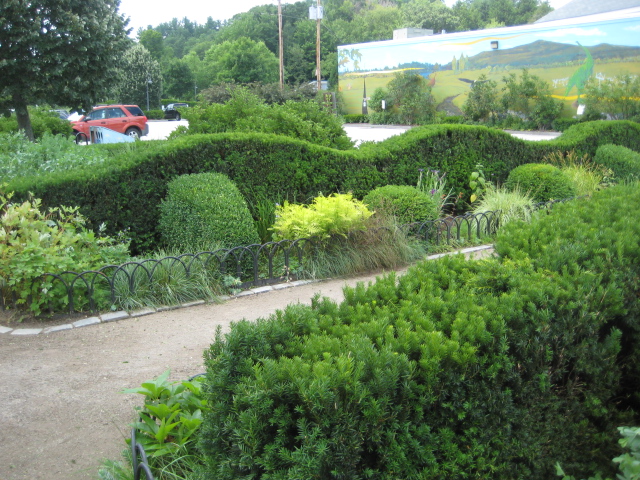
Chanticleer takes full advantage of every inch of soil for gardening, including the parking lot. The plant list in the parking lot rivals any public garden in the world. Even as you get out of your car, the tone is set for a special experience. Why can't every parking lot follow suit?

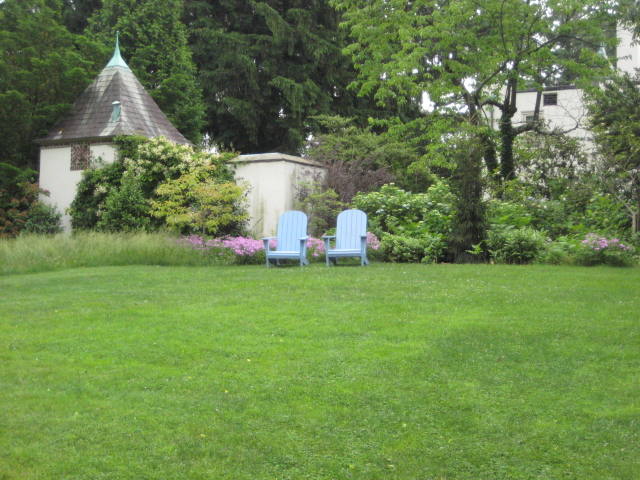
Have a Seat at Chanticleer


Chanticleer, the pleasure garden in Wayne, PA, is right up there with Great Dixter on the creativity scale. I visited the garden last weekend while I was in Pennsylvania. Chanticleer, was once the country estate of Adolph Rosengarten, Sr. and his wife Christine who bought the property in the first decade of the last century.  Rosengarten made his fortune in the pharmaceuticals industry and in 1990 his son left the entire property with an endowment "for the enjoyment and education of the public."

Like all good gardens, Chanticleer combines choice plants with thoughtful design. Chanticleer, like Great Dixter, goes one step farther, where experimentation is the mantra. Both gardens have a vitality and energy produced by change. The creativity doesn't end with horticulture at Chanticleer. During the winter season, the staff is busy creating unique chairs and benches that are placed throughout the garden adding to the unique character of Chanticleer.

The seating at Chanticleer and Wave Hill inspired me to pay closer attention to that aspect of the garden in the Peterborough parks. About a decade ago, I designed signature Adirondack chairs for Putnam Park and the Boccelli Garden, and then several years later, Ron Higgins installed the whimsical stone benches at Teixeira Park. My feeling was that each park should have its own unique flavor and I was certainly inspired by Chanticleer.
LinkWithin

Related Posts with Thumbnails