The gardener's eye

The Gardener's Eye

Showing posts with label Lynden Miller. Show all posts

Saturday, January 21, 2017

You Are Welcome Here


I have just returned from a visit to New York City to hear a lecture by Bill Noble on the gardens of the Cornish Colony in New Hampshire. I purposefully choose a hotel near the High Line when I am in New York and I had a nice walk there on Thursday morning. The grasses and perennials had not been cut down yet and looked spectacular gently blowing in the breeze.

I go to the High Line for inspiration. When I was designing public spaces in Peterborough, my goal was to create gardens of the highest quality possible with the resources available. As I studied public spaces, especially under the mentorship of my friend Lynden Miller, I began to learn the importance of making public spaces available to everyone. Lynden, who has designed many remarkable gardens in New York City, taught me many lessons about making everyone, no matter what their socioeconomic situation, welcome in public spaces.

The Friends of the High Line have taken inclusiveness a step further. At every entrance to the High Line, there are new placards welcoming all people to this public space. They are making a political statement against "the divisive, hateful speech we are hearing and witnessing across our country." I agree with the Friends of the High Line, this is a crucial moment to take a stand and I applaud their commitment to make "equitable and open spaces" that reflect not only the diversity of their community, but of our country and our world.

Sunday, April 26, 2015

Peterborough Parks: A Public/Private Partnership Talk


Tuesday I will be giving talk to to the Littleton, MA Garden Club on how the Peterborough Parks Committee creates and maintains the public gardens in Peterborough. I am excited to share my recipe for success, much of which I learned from Lynden B. Miller, who designs public gardens in New York City.

Here is part of the handout I will be giving the participants:

1) Design only what you can maintain at the highest level. Visit the best possible public and private gardens you can for inspiration. Make it gorgeous and keep it that way. Long-term maintenance is the key. Prepare soil properly from the onset.

2) Funding: start slow and show what you’ve done and grow. Keep trying to get grants even if you fail. Leverage success using volunteers to get public funding, public support and grants. Work toward a long-term endowment.

3) Mixed border works well for four-season beauty. Start with what it looks like in winter using hardscape and plants with winter interest (bark, berry, structure). Foliage is more important than flowers. Use the best and biggest plants you can get. Each park has its own mission statement or intention.

4) Set time and days so volunteers can incorporate time into their schedule. Have a specific plan for what needs to be accomplished each week.

5) Vandalism: Repair damage as soon as you see it!

“Make it gorgeous and they will come. Keep it that way and they will help.”
Lynden B. Miller

Wednesday, March 26, 2014

Harbinger of Spring


Adonis amurenis at the NYBG Ladies' Border

….now I need some for my garden….


Saturday, February 15, 2014

Clement Lecture informs New York Visit

In late October last year, I attended a NYBG lecture by French gardener, ecologist and philosopher Gilles Clement. I traveled from New Hampshire and also visited the new Native Plant Garden at NYBG, The High Line, the Hudson River Park and The Brine Garden, a private garden in Pawling, NY. The gardens complimented the lecture perfectly.

Clement described a garden as a dream of what people want to obtain in the best conditions. The first gardens were a space surrounded by a fence to keep nature out. He talks about the Garden in Movement where plants physically move and the gardener chooses whether to remove a plant that grows in a path, for instance. He also talked about the Third Landscape or the abandoned spaces which are a refuge for biodiversity.


This is the Jane Watson Irwin Perennial Garden at The NYBG. It was designed by Lynden B. Miller and is a rich tapestry of texture and color. It is what gardeners would call a mixed border consisting of trees, shrubs, perennials, annuals, biennials and bulbs.

This is another garden designed by Lynden B. Miller. It is a public garden called the Chelsea Cove Entry Garden and it is located in Hudson River Park (Pier 62) in Manhattan. 


This is another view at the Chelsea Cove Entry Garden. This is clearly a designed garden. Clement would call this kind of public space a more traditional garden where living species of animal and plants that defy the gardener's control are excluded. 


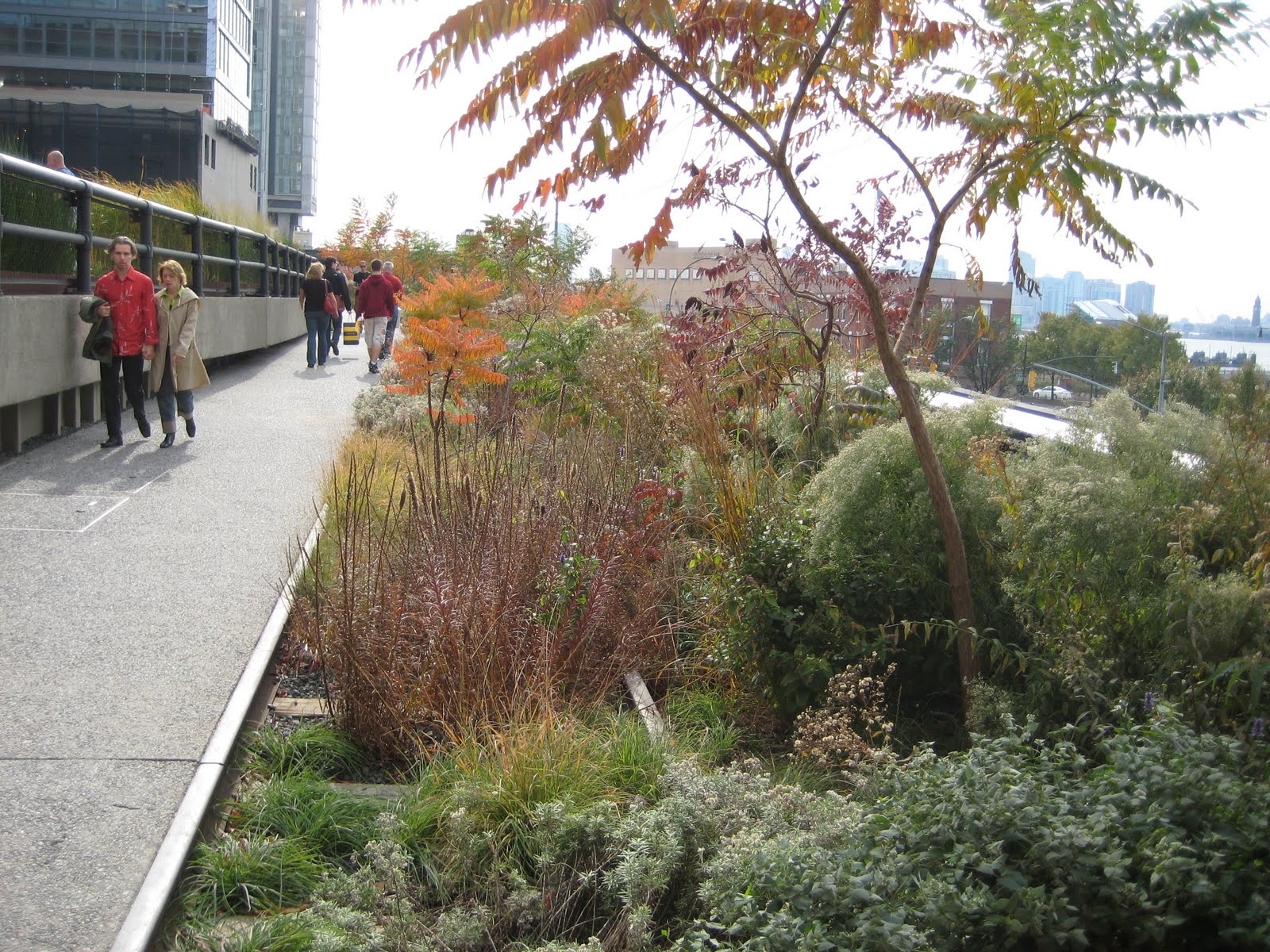
The High Line is a designed space that emulates or mimics Clement's Third Landscape. The High Line is a public garden on the sight of an abandoned elevated rail line in the Meatpacking District of Manhattan. The last train ran on the High Line in 1980 and for three decades self-seeded grasses, wildflowers and shrubs began growing. It created a beautiful leftover place where "indecision and living things that occupy it act freely".


The plantings at The High Line were designed by Piet Oudolf. Many plants that landed on the abandoned rail line, staghorn sumac (Rhus typhina), for instance, were used by Oudolf in his design. 


But this public space, like the work of Lynden B. Miller, is very much a designed landscape. This creeping raspberry (Rubus calycinoides) is an Asian native that would never have found its way to the High Line without Oudolf's invitation.


Oudolf uses many American native grasses and prairie plants for a very natural effect.


His plantings are a fantasy of what naturalized on the High Line but requires a cadre of highly skilled gardeners to keep the natural plantings looking natural. It will be interesting to see how much control Oudolf and his team will exert over the garden as it matures. What I have observed so far, makes me believe nature will not be allowed to take its own course.


The new Native Plant Garden at the NYBG reminds one of Oudolf's more recent work but is even more natural looking. The plant palate is limited to plants native to northeastern North America. It looks pretty spectacular in its first season.


The arrangement of plants in the woodland garden reminds me of hikes that I have taken in the Appalachian Mountains. It is a fantasy of what might have been there before Europeans came to the Americas.


This combination of plants looks similar to Oudolf's mature style of intermingling rather than planting in blocks or drifts. You can see that both Oudolf and the designer at NYBG are imitating nature. In this case the palate of plants is strictly limited to natives and all exotics will be eliminated. Again, it will be interesting to see how much resources will be required to maintain this effect.


This large open planting at the Native Plant Garden at the NYBG looked very natural. In northeastern North America, a meadow like this would be in constant jeopardy of quickly becoming a forest. 


The Brine Garden in Pawling, NY was particularly interesting to visit after hearing Clement speak. This private garden was designed by Duncan and Julia Brine and uses a naturalistic and very untraditional approach. This Japanese cedar, Cryptomeria japonica ‘Yoshino’, is planted on the edge of the pathway partially obscuring the front door to the house.


Plants were left in the pathways for the visitor to walk around.  The planting style reminded me of Clement's Garden in Movement aesthetic where plants are permitted to grow wherever they want to grow. This six acre garden used many Asian plants close to the house and gradually switched to more native plants as one traveled away from the house.


This shrub was knocked over during a storm and had new vertical shoots emerging from the roots. Most gardeners would remove the windblown stems and allow the shrub to tidily regenerate.


Even trees blown over in a storm where left in place. It required climbing over some the trunks. This is a very untraditional approach indeed. Again I am reminded of Clement's Garden in Movement where "the gardener aids nature rather than enacting rigid plans". Clement has a theory of the Planetary Garden where the gardener is nature's advocate welcoming vagabond species from around the world. Of all the gardens I visited, the Brine Garden seemed to achieve what Clement espouses.

You can see Gilles Clement doing a very similar lecture in English here.

Thursday, October 28, 2010

Wave Hill, the High Line and Wagner Park All in One Day in October


Wave Hill's Flower Garden


Another View of the Flower Garden


The Entrance to the Marco Polo Stufano Conservatory


The Wild Garden


The Aquatic and Monocot Garden at Wave Hill


The Gansevoort Woodland on the High Line


The Washington Grasslands


The Diller-Von Furstenberg Sundeck


The Chelsea Grasslands


The 10th Avenue Square


Rhus glabra on the Sundeck


The Hot Border at Wagner Park


Leonotis leonurus and a Bright Orange Cuphea Make Great Companions


Maude, Tovah and Laura Enjoying the Hot Borders


Last Sunday, three gardening friends and I did a fearless day trip from New Hampshire to NYC and back to visit public gardens in the city. We left at 5:45 am and arrived at Wave Hill, the public garden in the Bronx, at about 10 am. The weather threatened but ended up being very cooperative. The view from the Pergola Overlook across the Hudson River to the Palisades was spectacular. We spent a lot time examining the plant combinations in the Flower Garden. We also visited the Wild Garden and the Aquatic and Monocot Gardens before having a nice lunch on the terrace at the Wave Hill House.

Next, we drove down the Henry Hudson Parkway to the High Line, the recently opened New York City Park, in the Meatpacking District in the Lower West Side of Manhattan. The High Line is a park built on an elevated 1930's freight rail structure. The planting design is inspired by the self-seeded volunteer plants that began to establish themselves after the train made its final delivery in 1980. There are more than 200 species of perennials, grasses, shrubs and trees in the park. The garden was designed by Dutch planting designer, Piet Oudolf. Oudolf is world famous for using grasses in his designs and was the perfect man to take on this project. We spent much of our time there analyzing the way in which one perennial or grass slowly interwove into the next forming a very natural looking tapestry.

Our final stop was Wagner Park, the Lynden B. Miller designed public garden in Battery Park City at the very tip of Manhattan. Some of us had never seen the Statue of Liberty which prominently held court in the Upper Bay where the Hudson River flows into the Atlantic Ocean. The lighting could not have been more beautiful. Wagner Park, like all Lynden's gardens, was meticulously maintained. There were two borders with contrasting hot and cool color themes. Our favorite gardens were the hot borders which were ablaze with a stunning combination of Leonotis leonurus paired with a bright orange cuphea.

We were back on the road by about 6 pm and in our beds by 10:45 pm. It very busy and inspiring day that was totally worth the effort.


Thursday, May 27, 2010

Rocky Dale Road Trip

The Annuals Area

Trees and Shrubs

Perennials

Amy Rose-White and me with my favorite annual, Coleus 'Compact Red'

The Car Loaded

Yesterday, I took my annual 3 1/2-hour-trek to one of my favorite nurseries, Rocky Dale Gardens in Bristol, VT with two gardening friends. I have been going to Rocky Dale for over a dozen years and it is always worth the trouble getting there. Rocky Dale specializes in rare and unusual woodies, perennials and annuals for the discriminating gardener. They have lovely display gardens that the owner, Ed Burke, has been renovating since he bought the nursery in 2004.

Amy Rose-White, the nursery manager and old friend, is extremely knowledgeable about anything that is grown in Zone 5. Every year, I email her a wish list for unusual annuals. She usually finds them for me at two nurseries in New York, Beds and Borders and Landcraft Environments. Beds and Borders supplies a coleus called 'Compact Red'. I first saw this coleus when I visited Lynden Miller's Sharon, CT garden. She also used it in all her public gardens. 'Compact Red' is a cascading plant with claret, edged with chartreuse, velvety foliage. It makes a wonderful edge of the border or container plant that compliments any color on the wheel.

Amy found two foliage plants, Solanum quitoense and Senecio petasitis, for me at Lancraft Environments. They describe the senecio as "native to the mountains of Oaxaca Mexico." Also known as "velvet groundsel gets its name from the large, mostly green tinged with plum velvety leaves." It takes full sun and can handle dry conditions. I am planning to place it in the borders in front of the pavilion at Depot Park. I will use the solanum, a member of a large genus that includes the eggplant and potatoes, in two large metal pots from India near the terrace in my own garden. Last year, I paired it with the 'Compact Red' coleus to great effect. Solanum quitoense has huge velvety leaves with purple hairs and menacing thorns that always attract comments from visitors.

Wednesday, March 3, 2010

The Education of a Public Gardener: 9/24/97


Lynden B. Miller (standing with red sweater) leading volunteers at the Conservatory Garden


Lynden's collage


The Conservatory Garden in Central Park


Bryant Park


Shady Border in Bryant Park


Cool beds in Wagner Park in Battery Park City


Wagner Park


Hot Beds in Wagner Park


My life as a gardener changed course on September 24, 1997. I had met public garden designer, Lynden B. Miller, in her Sharon, CT garden (under a foot of snow) for a winter garden tour in 1996. I returned to Sharon the following summer to see her garden and she was kind enough to extend an invitation to visit her in New York City and see her public gardens.

Lynden originally studied art at Smith College and was trained in horticulture at the New York Botanical Garden and Wave Hill in the 1970's. About 30 years ago, she spearheaded the restoration of the Conservatory Garden in Central Park. She went on to design public gardens at the New York Botanical Garden, Bryant Park and the New York Public Library Gardens, Wagner Park in Battery Park City and Columbia University to name a few.

When I visited Lynden and her husband, Leigh in New York, I got the chance to see some her artwork before visiting the gardens. Her collages were an early indicator of her eye for color, form and texture. Early the next morning, we walked to the Conservatory Garden on 105th Street for a volunteer gardening session. Lynden instructed the volunteers in a fall planting of pansies. The volunteers excitedly went about their given tasks for a couple of hours until the project was completed and Lynden gave me a private tour of this six acre oasis in the city. Her plantings looked magnificent and were having an end of the season grand finale.

Lynden then whisked me to the subway and we traveled from uptown to midtown for our next stop at Bryant Park on 42nd Street, behind the Public Library. Lynden buzzed like a bumblebee from one end of the park to the other with the head gardener discussing the changes that would take place during the next growing season. We hopped back on the subway for our final destination, Wagner Park, at the southernmost tip of Manhattan in Battery Park City. From the park, you can see Lady Liberty in the Upper Bay at the mouth of the Hudson River. The garden had been recently opened and had two sections. One section had flowers in hot, bright colors and the other area was comprised of cool shades of blue, mauve and pink with complimentary gray foliage.

That day was an exhilarating day for me. I knew I wanted to create something like this in my own town. Lynden taught me how to get volunteers to work together and how to procure the public and private funding that would be necessary to get the job done. I learned about designing a mixed border and she introduced me to dozens of plants, many that I use regularly now, for the first time. Her message, that became my mantra in the public gardens I helped create in Peterborough, was to "take on only what you can maintain at the highest level and to make it gorgeous and keep it that way."

Lynden specializes in urban parks and public places. She has repeatedly transformed neglected, derelict and dangerous public spaces into serene and beautiful parks that provide a moment of respite for the city dweller. But these principles can apply to any public space in the country or the city. I have used Lynden's formula in the parks in Peterborough, NH. Lynden has written a new book called Parks, Plants and People: Beautifying the Urban Landscape. In it she "describes the elements of successful public space and explains how to design, improve and maintain year-round plantings." If you are interested in improving the public spaces and parks in your town , this book should be your bible.

LinkWithin

Related Posts with Thumbnails