The gardener's eye

The Gardener's Eye

Showing posts with label Luciano Giubbilei. Show all posts

Saturday, June 4, 2016

Best in Show at Chelsea


Andy Sturgeon's modern Jurassic Garden for the Telegraph won Best in Show at Chelsea last week. His intention for the garden was quite ambitious. He explained "Fundamentally, I was making a simple connection between colossal geological events that shape our planet, vast timescales and man’s relatively fleeting and insignificant time on Earth." He used 17 "bony plates' made of bronze to represent the spine of a stegosaurus. For hardscape, he also used smooth oatmeal-colored limestone, complete with Jurassic fossils for the paths, and contrasted it with ancient boulders quarried from the Isle of Purbeck in Dorset.

To my eye, the garden was a bit visually jarring. Although this garden was beautifully executed, I don't believe it will stand the test of time the way the last two winners, Dan Pearson or Luciano Giubbilei, will. It came across as trendy, but not timeless.


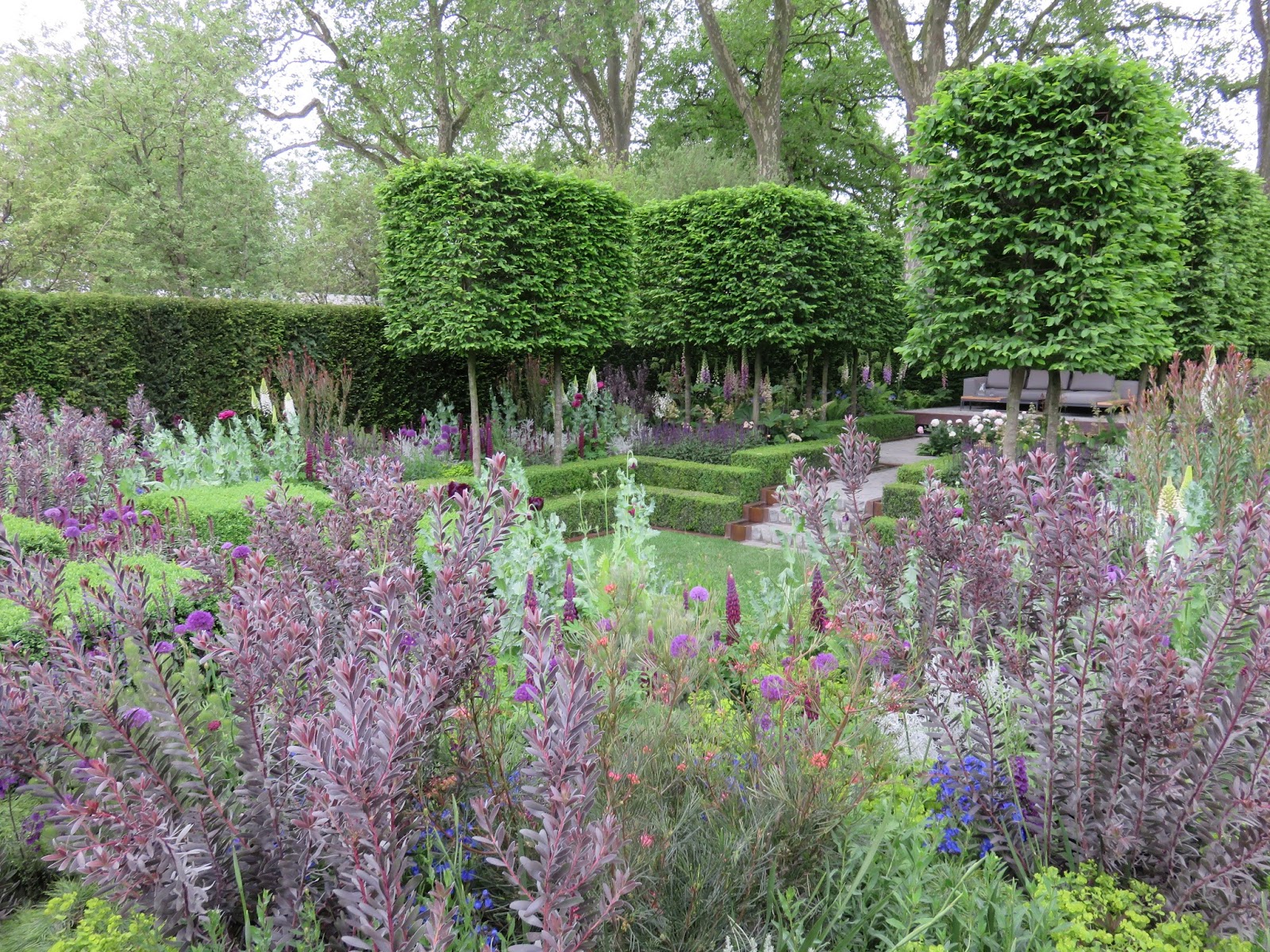

The Husqvarna Garden by Australian designer Charlie Albone, which won a Silver-Gilt award, was one of the few show gardens conceived along traditional formal lines. Perhaps the design erred on the side of being too safe and traditional, but I thought the way the plants were put together was beautiful.


Thursday, March 24, 2016

Wave Hill's Chionodoxa are Back and So Am I


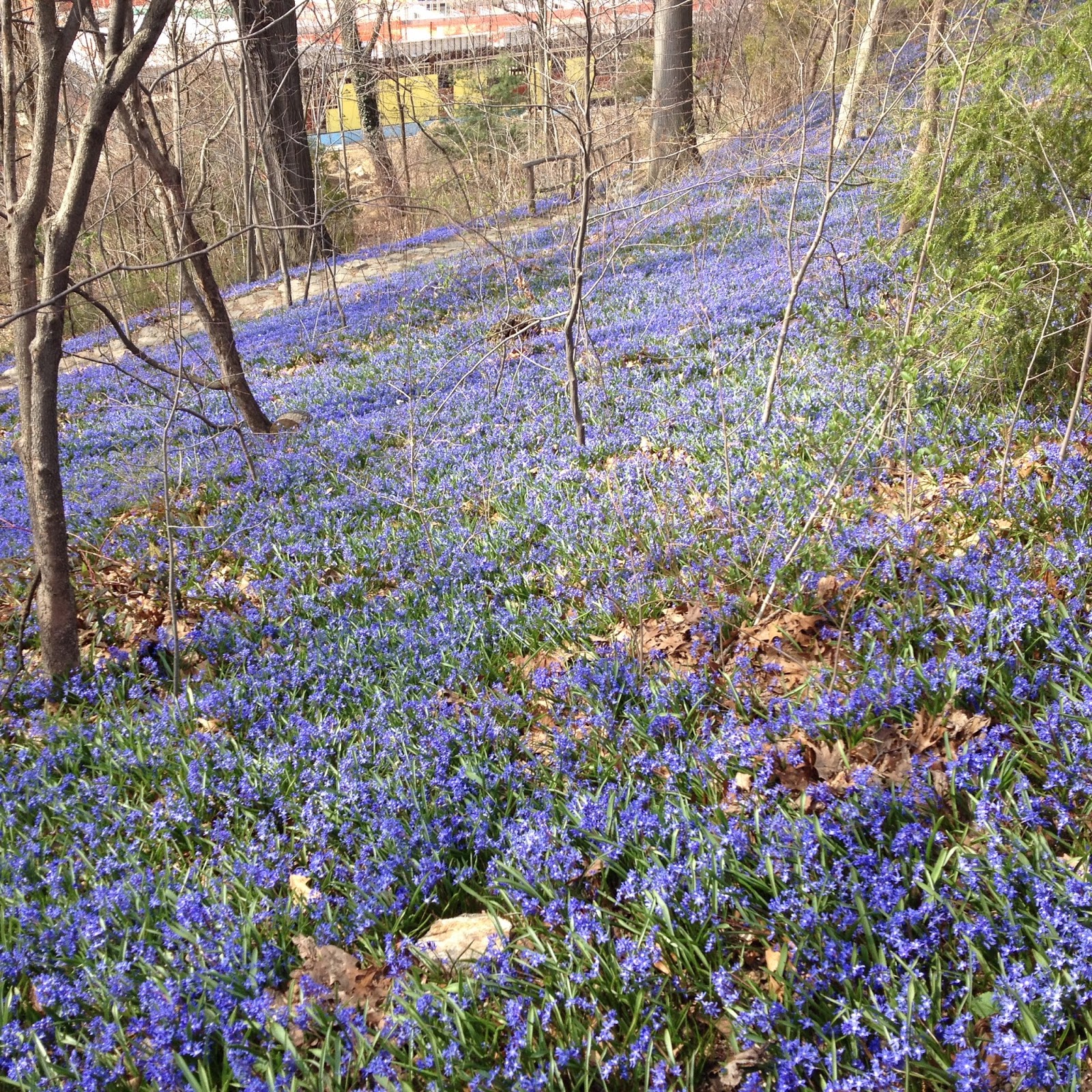
I have been on hiatus from blogging but a recent visit to Wave Hill in the Bronx during peak Chionodoxa sardensis season has inspired me to return. I was at lecture by Luciano Giubbilei at the New York Botanical Garden today and took a detour to nearby Wave Hill to see the drifts of glory-in-the-snow on the slope of the Abrons Woodland. The beautiful blue minor bulb has naturalized in the woodland as well as in the lawn under large trees and even in the Flower Garden. I hope my own woodland garden might get the blues this badly one day.


Monday, June 1, 2015

Luciano Giubbilei's Border at Great Dixter


While we were at Great Dixter, our tour guide, Rachael Dodd, mentioned that she has been collaborating with last year's Best in Show winner, Luciano Giubbilei, on a trial border in the vegetable garden at Great Dixter. Giubbilei, an Italian, had designed gardens for clients that reflected his heritage and were comprised primarily of hardscape and clipped hornbeam, yew, boxwood and beech. After he created his 2011 Chelsea garden, he wanted to get a greater understanding of the herbaceous elements of garden design. Fergus Garrett invited him to have 'residency' at Great Dixter and gave him a small plot where Giubbilei can get his hands dirty and experiment with planting techniques and combinations. James Horner, also a former Christopher Lloyd scholar worked with him on his Chelsea Flower Show winning garden.


Euphorbias were a main feature of the garden in May


Cow's parsley was another feature


The garden will also have another peak in autumn when the tall Eupatorium are in bloom.


Rachael Dodd gave a tour that was delightful and informative. Rachael was a former Christopher Lloyd scholar and has continued on at Great Dixter. Fergus Garrett must be doing something right to attract such enthusiastic and knowledgeable students and staff.


Luciano Giubbilei's Gold Medal winning garden at the 2014 Chelsea Flower Show. This planting was a result of his collaboration with Dixter-trained James Horner who worked with Giubbilei, overseen by Fergus Garrett, on in his border at Great Dixter.

Sunday, March 2, 2014

Small Gardens Are Like Short Films

Quotes from  ‘The Oscar-Nominated Short Films 2014: Live Action’

“12 Years a Slave” Director Steve McQueen
"The structure of short film is all about narrative."

"You have to say a lot in a short period of time. You think, 'How do I do that? How do I have the maximum impact within a time restriction?' But it could be actually much more effective than a long film. All this thing about short and long--its all about whether it is good or not. Often a short film can be better than a long film. It has nothing to do with length. It has to do with intelligence."


Luciano Giubbilei Chelsea Flower Show Garden


 Matthew Modine Actor and Shorts Director
"As artists you have to find someplace where you can go and find quiet and hear yourself; to hear your voice, because it is small."


Peter Wooster's Garden, Roxbury, CT

2013 Shorts Winner Shawn Christensen
"You have one idea, one notion, and you can take that idea all the way. If it is a strong idea, you can just explore it and you don't have to worry about being complicated. You can do that one simple idea."


Sakonnet Gardens, Little Compton, RI

Peter Webber Director "Girl with a Pearl Earring"
"There can be a purity about a short film. You can take a very simple pure idea...and make it purely cinematic."

"There is something much purer about working with a smaller budget or working on a smaller canvas."

"Short film is a real skill. It is like writing a Haiku."

"You need to have a really good story to tell and you need to tell it really well."


Rosemary Verey's Potager Garden, Cirencester, England

Jim Field Smith Director "She's Out of My League"
"The constraints of making a short sometimes end up being the strongest points."


Michael Trapp's Garden, West Corwall, CT

Sunday, December 18, 2011

Villa Gamberaia: Source of Inspiration


The Water Parterre at Villa Gamberaia

I had the good fortune to attend the Chelsea Flower Show on two occasions. Each time, I was struck by the simple modern design of two foreigners: Swedish designer, Ulf Nordfjell, in 2007 and the Italian garden designer, Luciano Giubbilei last May.

Nordfjell's garden was a tribute to Carl Linnaeus and used a Swedish steel, timber and granite elements in a very simple but elegant design. The plant palette consisted of plants known to be cultivated by Linnaeus and plants commonly grown in Swedish gardens. The Giubbilei garden was equally simple and elegant with a pool, bamboo pavilion and sculpture by Peter Randall-Page. He used pink, maroon and brown flowers planted in romantic drifts to great effect.

Both designers have published books chronicling their work. Ulf Nordfjell: Fourteen Gardens and The Gardens of Luciano Giubbilei were coincidentally both published in English last year. I found it fascinating that they both site Villa Gamberaia, the Tuscan masterpiece, as an inspiration.

Nordfjell noted that at Villa Gamberaia "I found what I have often missed in other gardens: architecture, design, and the art of the garden, all unified by the stylistic ideals of the Renaissance man." He goes on to say that the villa "despite its age, feels like a modern and cohesively designed garden." Nordfjell fantasied "in my mind's eye, I find it irresistible to replace today's well-manucred lawns with ethereal beauty of the Tuscan landscape, creating an intimate tribute to nature from its own wildflowers: meadows of grape hyacinths, primulas. daisies and salvias, framed by formal hedging. This would, if such a thing is possible, enhance the genius of the Renaissance garden still further, forming a meeting between garden and the natural landscape, created by our human longing for beauty."

In his late teens, Giubbilei spent some time volunteering at Villa Gamberaia, being mentored by the head gardener, Silvano, who had worked there since the end of the Second World War. When Giubbilei left the villa, "Silvano presented him with a black-and-white record of the garden, a book that would prove a significant influence once his design career was under way. The atmospheric photographs by Balthazar Korab depicted both the architecture and mood of the garden: deep, rich shadows played on intensely lit surfaces, their textures almost tangible." Using these photographs as a model, Giubbilei "wanted to seduce people into entering gardens using the architecture of planting, the texture of the surfaces and the arrangement of sculpture, containers and furniture. His intention was never to imitate but to explore, to understand the sentiment behind the garden and the intensely motivating images."

During a family trip to Italy, I visited Villa Gamberaia in 2000. I was struck by the simplicity of the design and the intimacy of the scale of the garden. I learned the importance of having both shade and light in the garden and the clever use of terracing to divide spaces on a sloped site. I realized that I long for a design that is well-articulated and doesn't attempt to do too many things at once. It reminds me of the advice of an English professor who encouraged us "to say it, say it and say it again." The same clarity of intention is true about effective garden design.

Both of these designers have helped me distill what I found so alluring about Villa Gamberaia. Luciano Giubbilei has reminded me of the importance being influenced by other gardens and art but not to copy them verbatim and Ulf Nordfjell has galvanized in my mind the importance of well-chosen plants to create a desired effect within the confines of a strong design.

Thursday, May 26, 2011

Three Favorite Views at Chelsea


The Laurent-Perrier Garden designed by Luciano Giubbilei


Irish Sky Garden designed by Diarmund Gavin


The Daily Telegraph Garden designed by Cleve West

We spent the last day of The Best of English Gardens tour at the Chelsea Flower Show. We arrived on site as soon as it opened and were able to take a look before the throngs of people descended. It was a gorgeous day and a very comfortable temperature.

Almost every display garden had something that I admired but several had elements that I didn't think enhanced the gardens. Diarmund Gavin's beautiful garden employed a distracting "pod" or floating garden that was lifted into the air by a gigantic crane. It came off as more of a publicity stunt than inspiring gardening. That is unfortunate because I liked the rest of the garden very much. The garden consisted of a pleasing combination of yew, boxwood and hornbeam topiaries mixed with drifts of ornamental grasses.

The Laurent-Perrier Garden designed by Luciano Giubbilei was one of the best gardens, I thought. This Italian designer is known for impeccable formal spaces with very little herbaceous material. He broke away from that formula with two tasteful and harmonious herbaceous borders that felt very English. I thought the boulders sculpted by Peter Randall-Page were striking. The garden also had a dozen mature Parrotia persica specimens which were limbed up in a very elegant fashion.

The Best in Show Award went to Cleve West's garden for the Daily Telegraph. West's garden had a Roman ruin theme and had several stone columns created by pair of sculptors from the south of France named Serge Bottagisio and Agnes Decoux. The columns were inspired by the Roman ruins at Ptolemais, in Libya and the garden walls were made of golden Cotswolds stone. The sumptuous and subdued herbaceous planting complimented the wall which was painted a mellow golden color.

I was sad to see The Best of English Gardens tour end but I am anxious to return to my own garden to try put some new ideas, inspired by the tour, into place.

LinkWithin

Related Posts with Thumbnails