The gardener's eye
The Gardener's Eye
Monday, March 23, 2015
Sunday, March 8, 2015
Gorda Peak Hike
I recently returned from a vacation Virgin Gorda in the British Virgin Islands. In 1974, Laurance Rockefeller donated approximately 250 acres of land which became Gorda Peak National Park. Gorda Peak is the highest point on Virgin Gorda at 1,370 ft. It is unique because it is one last remaining examples of Caribbean dry forest. There is a hiking trail to the peak, about a 30 minute walk. The vegetation varies with elevation: starting with dry scrub forest and becoming more moist as the elevation increases. At the top of the trail there is a lookout tower which has dramatic panorama views of the British Virgin Islands. There were many varieties of orchids and bromeliads along the trail. It was exciting to see tender plants that I use as annuals in their natural habitat.
Tuesday, January 20, 2015
The Aftereffects of Subtraction in The Hall With Balls
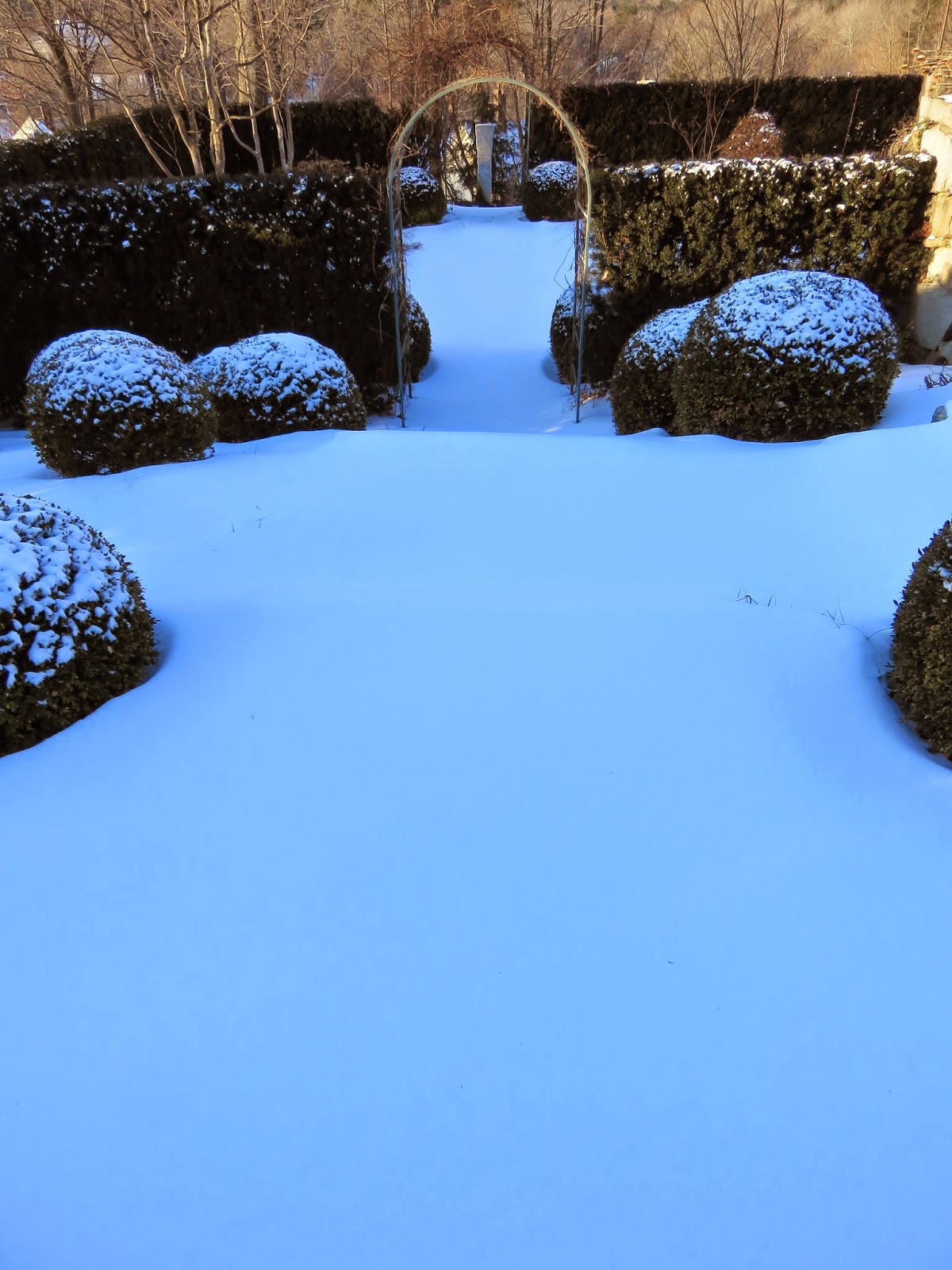
The Hall with Balls was particularly serene this past week. I always love the round boxwoods dusted with snow. The Cornus officinalis tree can be seen off center in this view and to the far left below.
Several posts ago, I made a decision to remove two upright Junipers. In the process, a granite wall, which can be seen to the left of the steps, was revealed. I am very pleased with the simplicity that resulted.
The granite post in the Woodland Garden can be seen through the two archways looking particularly beautiful as a focal point calling the eye and the visitor forward.
Sunday, January 18, 2015
Cedar Waxwings at Teixeira Park
Earlier this week, I visited Teixeira Park and was pleased to find a flock of Cedar Waxwings devouring the fruit of the Malus 'Prairiefire' trees grove planted in a small grove along Union Street in West Peterborough. My intention, when we redesigned the park, was for it to have a wild flavor that would attract wildlife; especially birds and butterflies. Later, as I learned more, I concentrated on planting native herbaceous plants to attract insects to promote biodiversity.
Don and Lillian Stokes, the well-known birding experts and authors who live in nearby Hancock, NH, are gardening friends. In 2005, they came to visit Teixeira Park to give me ideas on how to attract birds and butterflies. They suggested planting a grove of crabapples along the street to attract birds. The idea was that the trees would provide food but would also serve as a stepping-stone for the birds to enter the park from the woods across the street. They suggested using native dogwoods, viburnums and shadblows. They also pointed out that the Nubanusit River provided the water that birds require. All the stars were aligned for birds: food, water, cover and nesting oppurtunities.
Six years later, I was pleased to read in Doug Talamay's book Bringing Nature Home that crabapples are fifth on the list of woody plants that support the order of Lepidoptera (the moths and butterflies), an important representative of the insect herbivores. Insect herbivores in turn are necessary for the biodiversity of other wildlife including birds. There are only four species of crabapples in the United States. Crabapples are unique in that the leaf chemistry of the alien crabapples (Malus 'Prairiefire' included) is indistinguishable from native crabapples to insects which often have a special evolutionary relationship with native species.
Birds, on the other hand, don't have a specific evolutionary relationship with their food: they will eat almost anything. So planting the grove of Malus 'Prairiefire' served two purposes. It provided food (fruit) and shelter for the birds while providing food (leaves) for 311 species of moths and butterflies which resulted in an overall increase of biodiversity. From a garden beauty/garden ecosystem perspective, it is having your fruit and eating it too.
Sunday, December 14, 2014
Taking the Road Less Traveled on Pack Monadnock
Two roads diverged in a White Wood called Pack Monadnock
The more traveled road
I took the less traveled road
It made all the difference
Actually, it made no difference; they both went to the same place, the top
Two roads diverged in a yellow wood,
And sorry I could not travel both
And be one traveler, long I stood
And looked down one as far as I could
To where it bent in the undergrowth;
Then took the other, as just as fair,
And having perhaps the better claim
Because it was grassy and wanted wear,
Though as for that the passing there
Had worn them really about the same,
And both that morning equally lay
In leaves no step had trodden black.
Oh, I kept the first for another day!
Yet knowing how way leads on to way
I doubted if I should ever come back.
I shall be telling this with a sigh
Somewhere ages and ages hence:
Two roads diverged in a wood, and I,
I took the one less traveled by,
And that has made all the difference.
The Road Not Taken by Robert Frost
New Hampshire, 1915
Sunday, November 30, 2014
Subtraction in a Maturing Garden
Over a decade ago, I planted a pair of small Juniperus scopulorum 'Skyrocket' trees to add a vertical accent on the slope connecting the Upper garden with Lower Garden. Later, I added granite steps and planted it with boxwoods which gave the impression of balls rolling down the hill. The junipers flourished and became quite handsome but in the last several years they have grown out of scale for the space and suffered snow damage. In the mean time, the yew hedge that encloses the area has finally become a wall and the Cornus officinialis in the center of the space is large enough to become a focal point in the space.
After our snow this Thanksgiving, it became clear that the junipers were more of a detriment than a virtue in the garden. I removed them today and I don't regret my decision.
The pair of Juniperus scopulorum 'Skyrocket' trees in the Hall with Balls.
Now that the junipers are gone, the granite retaining wall can be seen once more.
The "before view" from the Upper Garden
and the "after view" with Cornus officinialis to the left.
A pleasant surprise was the view from the Master Bedroom. The boxwoods that seem to be rolling down the hill are exposed as well as the Cornus officinialis in the center of the Hall with Balls. The round boxwoods have been used as a unifying element in the garden. I like the idea that the boxwoods give the impression that they have rolled from the Upper Garden down through the Hall with Balls into the Lower gardena and down into the Woodland Garden below. I did a series of posts earlier this year experimenting with ideas about how to place boxwoods in the rest of garden; its time to think about it once more.
Sunday, November 9, 2014
Subscribe to:
Posts (Atom)