The gardener's eye

The Gardener's Eye

Sunday, September 23, 2012

Farewell Malus 'Red Jade'

I planted a weeping crabapple called 'Red Jade' in the Lower Garden in 1993 and I have been training its canopy ever since. It was barely a whip when I started and I have enjoyed watching it mature. In the springtime, the pendulous branches are covered with light pink apple blossoms and in the fall, a flock of cedar waxwings devour the persistent small red fruit in less than a day. However, this Malus doesn't always look its best in the summer when the leaves prematurely turn brown and fall off. It has also been getting too large for its location near the terrace. It is taking more and more light from the perennial border and as it grows to its mature size, 15 tall and nearly 20 feet wide, it is clear that it will be too big for the site.

I have been contemplating removing the tree for about a year. A very early spring with a sudden cold snap made my decision easier when all the buds froze and I realized that there would be no fruit this autumn. Last week, I removed the tree. It was sad, but also liberating. The scale of the plantings in the mixed border felt better immediately. As the Acer griseum x 'Gingerbread' on the opposite side of the terrace has gotten larger, the terrace has become too shady. Now I have spot on the terrace for all my sun-loving potted plants which I have been having an increasingly more difficult time making happy in the shade.

After I amended the soil with compost, I planted a small shrub called Leptodermis oblonga and two Persicaria 'S'cunnet Pink' in place of the crabapple. Leptodermis oblonga, also known as false lilac, grows to about 3 feet and  has small fragrant purple blooms that begin in spring and last all summer. Persicaria 'S'cunnet Pink' is a plant from Opus, Ed Bowen's nano-nursery in Little Compton, RI. Ed selected this plant for its "6+ inch tapers of pink flowers, each with a deeper pink eye, from still deeper calyces atop 3-5 foot stems midsummer to frost." Ed says it is a Zone 6 plant. I'm hoping the site, against a newly revealed stone wall with southern exposure, will be make this beauty happy.


Before...


After


Before...


After


Before...


After


Friday, September 21, 2012

Peterborough Parks in Mid-September


Volunteers Amy and Laura displaying Teamwork


The Pavilion Garden at Depot Park


The yellow foliage of Arundo donax 'Gold Variegated' reads well against the yew hedge


Salvia 'Indigo Spires', Solanum quitoense and Nicotiana langdorfii


Cupea 'David Verity' at the Pavilion Garden at Depot Park


 Boccelli Garden


 The Developing Rain Garden at Putnam Park


The Planter at Putnam Park planted with Tagetes 'Cinnabar', grown from seed I got at Great Dixter

September is probably my favorite month in the garden. I tend to favor plants that get blowsy and look voluptuous at the end of summer. The tender annuals always look their best in New Hampshire at this time of year. This moment in the garden needs to be cherished for an early frost could make it suddenly vanish.

Sunday, September 16, 2012

Heptacodium miconioides, Star of the September Woodland Garden


Heptacodium miconioides, in bloom, behind the Blue Bench Terrace and Shed


Three views of dozens of butterflies collecting nectar

It had never crossed my mind, until I read Doug Tallamy's book, Bringing Nature Home, that butterflies might be in trees. Now that I have limbed up the oak tree in the woodland garden, the butterflies seemed to have made a pilgrimage to the newly revealed Heptacodium miconioides tree behind the shed in the lower garden.

Heptacodium miconioides, or the Seven-Son flower, 15-20 foot tall China-native that has clusters of seven white flowers which bloom in late summer. The flowers are followed by small redish-purple friuts on persistent, and equally ornamental, rose-colored calyces that look good well into autumn. As I mentioned in earlier posts, Heptacodium miconioides also has exfoliating tan bark that is a garden feature throughout the winter.

Wednesday, August 29, 2012

Peter's Gate Pots


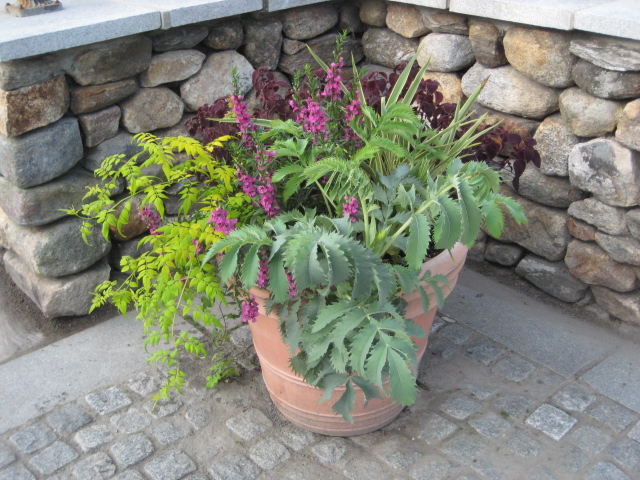
The pots at Peter's Gate in Depot Park have filled out nicely.  This year's combination consists of Melianthus major, Coleus 'Compact Red',  Jasminum 'Fiona Sunrise' Phormium tenax 'Wings of Gold' and Angelonia 'Raspberry'.

Monday, August 20, 2012

Backlit Post


As I was walking home from work this evening, I got a glimpse of the granite post in the Woodland Garden. We have had plenty of rain in the last few weeks, and the weeding and boxwood trimming are done. It was time to take it all in for a moment. 

Thursday, August 2, 2012

Training the Eye on the High Line

I visited the High Line in Manhattan for the fourth time lat month. There is always a lot to learn observing these public plantings and it was great to finally see them in full bloom during the summer. I was focusing on the way the plants were put together by Oudolf: the combinations of contrasting textures woven together in a very naturalistic way. There is a repetition of plants but they are interspersed almost randomly, rather than planted in the waves that Gertrude Jekyll might have employed nearly a century ago. The prairie plantings in the Chelsea Grasslands gave me ideas for the new rain garden at Putnam Park and the Ruin Garden at Teixeira Park while the new woodland plantings at Falcone Flyover has inspired ideas for the new woodland-edge plantings at Teixeira Park and in my own garden.


Classic Oudolf combination: Echinacea purpurea and Eryngium yuccifolium


 Another view of Echinacea purpurea and Eryngium yuccifolium in the Chelsea Grasslands


Grass and Perennial Combination


Monarda fistulosa ‘Claire Grace’, Panicum virgatum ‘Shenandoah’ and Rudbeckia subtomentosa


Heuchera ‘Amethyst Mist’ and a grass in the Philip A. and Lisa Maria Falcone Flyover


Epimediums, Pachysandra procumbens, Liriope muscari ‘Densiflora’, ferns and Asarum canadense


Brunnera macrophylla ‘Jack Frost’ below the huge leaves of Magnolia macrophylla var. ashei

Sunday, July 15, 2012

The Ruin Garden Evolves: Letting Nature Take its Course


The Ruin Garden at Teixeira Park


Textures in the Garden: Calamagrostis brachytricha in the foreground


Volunteer Goldenrod allowed to enter the garden


Echinacea, Butterflyweed and the fine foliage of Vernonia lettermannii 'Iron Butterfly' in foreground


Close up of the original Asclepias tuberosa 'Gay Butterflies'  and Heliopsis helianthoides 'Summer Nights'

Asclepias tuberosa 'Gay Butterflies' and Heliopsis helianthoides 'Summer Nights' are the stars of the Ruin Garden in early July. They are good companions. Asclepias tuberosa 'Gay Butterflies'  is a short and squat plant of about 24" with bright orange flowers.  Heliopsis helianthoides 'Summer Nights' is slim, airy and stands about 3-4 feet tall on elegant red-tinged stems.  The golden flowers tower above the low granite walls at the Ruin Garden and can be seen from the sidewalk on Union Street inviting the passerby to explore the garden.

Both plants are cultivars of Native American plants that attract butterflies. The seeds of Heliopsis helianthoides 'Summer Nights' also provide food for goldfinches. Interestingly, both of these plants are self-seeding in the garden. I want the Ruin Garden to have a wild feeling and I am letting some of the volunteers grow where they please but I am editing out other plants that may overwhelm neighboring plants. 

This garden is a bit of an experiment for me. I usually like to control what happens in the garden. I am working on removing any unhappy species and letting the happy plants be fruitful and multiply. I want the Ruin Garden to attract birds and butterflies and be full of a diverse combination of plants that look good throughout the year. It is more difficult task to do well than one might think.

LinkWithin

Related Posts with Thumbnails