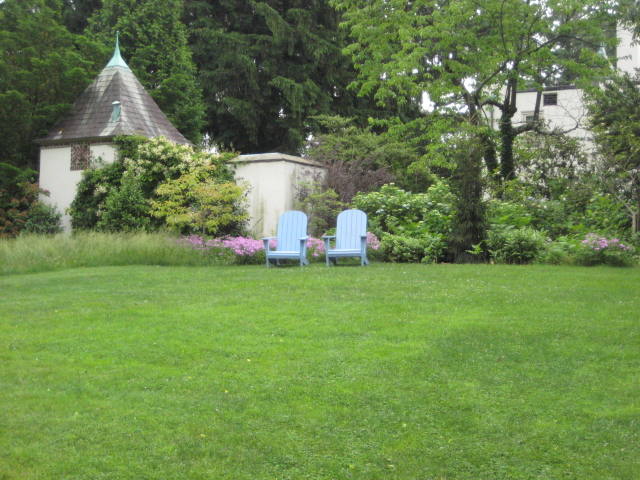
The Garden Conservancy Open Day in the Monadnock Region will be next Saturday, June 30. My garden, along with four other gardens, will be open to the public from 10 am to 4 pm. If you are in the area, please come by for a visit. Each garden is different from the next and the tour would make for a lovely day. The public gardens that I work on in Peterborough, which are always open to the public, are also included on the Open Days Tour. Volunteer gardeners will be at the Pavilion Garden in Depot Park in downtown Peterborough (near the Toadstool Bookshop) to answer questions and distribute maps to the other public gardens.
The gardener's eye
The Gardener's Eye
Saturday, June 23, 2012
Monadnock Region Open Day June 30
The Garden Conservancy Open Day in the Monadnock Region will be next Saturday, June 30. My garden, along with four other gardens, will be open to the public from 10 am to 4 pm. If you are in the area, please come by for a visit. Each garden is different from the next and the tour would make for a lovely day. The public gardens that I work on in Peterborough, which are always open to the public, are also included on the Open Days Tour. Volunteer gardeners will be at the Pavilion Garden in Depot Park in downtown Peterborough (near the Toadstool Bookshop) to answer questions and distribute maps to the other public gardens.
Friday, June 15, 2012
Saturday, June 9, 2012
Have a Seat at Chanticleer
Chanticleer, the pleasure garden in Wayne, PA, is right up there with Great Dixter on the creativity scale. I visited the garden last weekend while I was in Pennsylvania. Chanticleer, was once the country estate of Adolph Rosengarten, Sr. and his wife Christine who bought the property in the first decade of the last century. Rosengarten made his fortune in the pharmaceuticals industry and in 1990 his son left the entire property with an endowment "for the enjoyment and education of the public."
Like all good gardens, Chanticleer combines choice plants with thoughtful design. Chanticleer, like Great Dixter, goes one step farther, where experimentation is the mantra. Both gardens have a vitality and energy produced by change. The creativity doesn't end with horticulture at Chanticleer. During the winter season, the staff is busy creating unique chairs and benches that are placed throughout the garden adding to the unique character of Chanticleer.
The seating at Chanticleer and Wave Hill inspired me to pay closer attention to that aspect of the garden in the Peterborough parks. About a decade ago, I designed signature Adirondack chairs for Putnam Park and the Boccelli Garden, and then several years later, Ron Higgins installed the whimsical stone benches at Teixeira Park. My feeling was that each park should have its own unique flavor and I was certainly inspired by Chanticleer.
Tuesday, June 5, 2012
Martin's Greenhouse
The sign for Martin's Greenhouse on Rt 322 in Narvon, PA
A Salix Arbor
Some of the Plants for sale
The Greenhouse
Some Choice Annulas
More Annuals
One of the many varieties Hellebores: I think this is Hellebore niger x ericsmithii 'HGC Silvermoon'
Epimedium x youngianum 'Azusa'
My loot
I knew when I agreed to go with my college roommates to my 30th reunion at Franklin and Marshall College in Lancaster, PA that there would be some horticultural side trips. Top on my list was Martin's Greenhouse in nearby Narvon, PA, in the heart of the Amish Country. I first heard of Martin's Greenhouse from David Culp while visiting his garden in Downingtown, PA. David works for Sunny Border Nurseries and calls on Marion Martin, the owner of the nursery.
It is easy to miss the sign for the nursery when driving along Division Highway (RT 322) on the way from Downington to Lancaster. In fact, on my first trip there about ten years ago, I passed the nursery four or five times before I finally found it.
When you first arrive, the nursery doesn't look like much. But on closer examination, you will find a wide array of hard-to-find rare perennials, trees, shrubs and choice annuals. Marion has a particular interest in hellebores and has numerous varieties including some of David Culp's Brandywine hybrids. I was looking for woodland plants for my garden and went home with three different toad lilies, several epimediums, some ferns and our native ground cover, Mitella diphylla. I also found some choice coleus plants and a beautiful blue flowered annual, Streptocarpus 'Lady Slipper Blue Ice.'
If you are in Lancaster County in Pennsylvania don't miss Martin's Greenhouse. It is a gem of a nursery with a plethora of rare and unusual plants to choose from.
Martin's Greenhouse
5489 Division Highway
Narvon, PA 17555-9217
717-354-7546
martinsghse@juno.com
Monday, May 28, 2012
What's Modern Now: Axes, Focal Points and Plants at Chelsea
Thomas Hoblyn's Garden Inspired by Italian Renaissance Garden has a strong Axial Design
Tom Swift's Had a Series of Cedar Structures with an Axis and Focal Point
Sarah Price's Garden evoked the beauty of wild areas of the British countryside and employed a long axis without a Focal Point.
Cleve West's Best of Show winning design has a strong central axis and celebrated the heritage of British gardening
View of the Focal Point of Cleve West's Garden
This Long Axis View in Andy Sturgeon's Garden without a Focal Point, looked , to me, a lot like the Price Long Axis
Arne Maynard's Garden had a Modern Focal Point (photo credit RHS)
The informal feeling planting in Cleve West's Garden
Hoblyn's low perennial planting
Sturgeon's plantings in front of the pool with distracting copper Bubble "energy wave" sculpture
Lush planting in Maynard's Garden
Price's planting in the Telegraph Garden
Diarmuid Gavin's 'Magical Garden' was a giagantic 7 level pyramid without axes but one enormous ego-satisfying focal point that could be seen from any point on the grounds at the flower show
Another garden without an axis: Jihae Hwang's garden commemorating the 60th anniversary of the Korean conflict
Chris Beardshaw's garden inspired by the Furzey Gardens did not utilize an axis in its design
I am a sucker for strong axes and focal points in garden design. I think that is why I like English gardens so much. They almost always have a very clearly articulated design which I find appealing and probably reassuring. As we walked through Hidcote, Barnsley House, Sissinghurst and the other gardens on our tour, I asked the participants to looks for axes and focal points and encouraged them to sit in every chair or bench available to discover design elements.
I decided, as we entered the 2012 Chelsea Flower Show, to compare the designs (especially if they employed axes and focal points) and the plantings of the show gardens and determine if anything ground breaking was introduced this year.
Nearly all the gold winning designs had a single axis with a focal point. Many also had cross axes perpendicular to the main axis. Most of the gardens had hedges and some sort of topiary. Interestingly, the herbaceous plantings were very similar as well. They tended to have a low naturalistic meadow feel with a mauve/pink, purple and/or purple-brown palette of planting. Few bright colors were used. This type of planting was reminiscent of many of the gardens I remember from last year's Chelsea Show.
As a whole, I thought the designs were well-executed and the plants were in excellent condition. However, I felt like many of the gardens felt very similar and the designers seemed to be playing it safe this year. Except for Diarmuid Gavin's 'Magical Garden', which I found rather odd, nothing seemed to be breaking new ground.
Subscribe to:
Posts (Atom)